Ep 9: REMIXED - The Brighton School and the Intersection of Melies, Smith, and Phalke
Updated: Jun 9
In this episode, we will continue to explore the films of G.A. Smith, as well as fellow Brighton filmmaker James Williamson, who were both part of what academics would later refer to as the Brighton School. We will examine how many creators of trick films share a background in magic, including Smith, Méliès, and Dadasaheb Phalke, whom we also briefly discuss. Additionally, we discuss producer and distributor Charles Urban, who distributed the films of G.A. Smith, James Williamson, and Georges Méliès, and the public’s growing interest in actuaries, which were sort of like short docudramas, culminating in our examination of the Charles Urban and Georges Méliès actuary, The Coronation of Edward VII, on which G.A. Smith may also have collaborated.
James Williamson and George Albert Smith are two of the most influential members of the film pioneers associated with what French film historian Georges Sadoul would later call “The Brighton School”; though the Cinematheque Francaise would later dismiss the term as “a convenience for later commentators”. The other two filmmakers normally associated with “The Brighton School” are Esme Collings and Alfred Darling. Alfred Darling, as we have already mentioned in this episode, was the Brighton-based engineer who invented the Biokam and sold G.A. Smith his first camera.

“The Brighton School” of filmmakers seems to mostly be defined by the fact that all the members were active around the same time and in the same area, though David Fisher points out that most of this work was filmed in Hove, rather than Brighton (Fisher, The history, 2022). Indeed, groups of independent film producers were active in many parts of England, as London was not the centralized seat of British film production until around 1915 (Librach, 2022).
James Williamson himself stated that he believed it was a coincidence that they all were active in Brighton at the same time. While Brighton owed much of its use as a filming location to its natural beauty, Williamson stated that the key ingredient in allowing the Brighton-based filmmakers to progress in the medium was the assistance of Alfred Darling, whom Williamson calls “a clever engineer who made a study of the requirements of film producers.” Williamson claims that it was only after meeting Darling that his filmmaking began in earnest (Fisher, The history, 2022).
Instead, the fundamental connection between many of the English filmmakers of the early years of cinema seems to be American-born film producer and distributor, Charles Urban. In fact, Urban was also associated with Georges Méliès, being the English distributor of Méliès’ films and collaborating with him on a film production. And it was through that film production that George Albert Smith was able to work with Méliès.

Charles Urban was a Cincinnati-born entrepreneur who, in 1895, came to manage a kinetoscope-photograph parlor in Detroit, before acquiring the Michigan rights to the Edison vitascope the following year. While touring Michigan and staging exhibitions of Edison vitascope films, he modified a vitascope to increase the capacity of the take-up reel, or the reel that gathers up the film that has already been projected. Urban then commissioned New York phonograph engineer Walter Isaacs to create a hand-crank projector that integrated the Urban-designed higher capacity take-up reel, with the use of the hand crank allowing the projector to be operated without the use of electricity. This projector became known as the Bioscope and was completed in 1897, the same year as Urban left the U.S. In August of that year, Urban became the manager of the London office of the New York-based firm, Maguire and Baucus, (Librach, 2022) which had gained the exclusive rights to sell and exhibit Edison’s kinetoscopes and kinetoscope films in Mexico, the West Indies, Australia, South America, Europe and Asia (Rutgers, 2022).
In late 1894, Maguire and Baucus also established the Continental Commerce Company, which handled their business in Africa, Europe, and this was the name under which Maguire and Baucus did business in England. Only a month after taking over the London office, Urban moved the Continental Commerce Company to Warwick Court in London. In December of that year, Maguire and Baucus found itself at the center of a lawsuit brought by Edison for infringement of his motion picture patents (Rutgers, 2022). The following May, Urban reincorporated the Continental Commerce Company as the Warwick Trading Company, naming it after its location of Warwick Court, as he believed it to be “a good, solid British name” (Librach, 2022).

During this same period, Urban began making important business connections, one of whom was Cecil Hepworth. Urban commissioned Hepworth, at that time an inventor of photographic equipment, to fix some remaining issues with his projector, the Bioscope (Librach, 2022). Hepworth would later become an influential filmmaker. According to Dr. Simon Brown, associate Professor of Film and Television at Kingston University London, “A producer, director, writer and scenic photographer, Cecil Hepworth survived in the film business longer than any other British pioneer film-maker. … In the course of his career, Hepworth became one of the most respected, if not the most dynamic, figures in British cinema” (Brown, 2014).

The London-born Cecil Hepworth was the son of noted magic lantern showman, Thomas Cradock Hepworth, often credited as T.C. Hepworth. T.C. Hepworth, is also who, incidentally, succeeded John Henry Pepper, the showman who popularized Pepper’s Ghost, when Pepper fell out with the governing board at the Royal Polytechnic on Regent Street in London (Secord, Quick and Magical Shaper of Science, 2002).
1898 proved to be an important year for Charles Urban, for not only was he manufacturing his Hepworth-modified Bioscope, but he also acquired Alfred Darling’s Biokam. But more importantly, this is when he secured the distribution rights to important filmmakers, such as George Albert Smith, James Williamson, and Georges Méliès. As the turn of the century was approaching, filmmaking was changing in fundamental ways. By 1905, the age of the nickelodeon was dawning, and as the late film historian and writer, Carlos Clarens stated: “Trickery for the sake of trickery lost much of its allure during the nickelodeon era (Clarens, 1997).
The spectacles that were the basis for trick films had grown out of the magic lantern tradition. During the first few years of moving pictures’ existence, no subject was necessary—just the wonder of seeing images move was enough for the audience, as the filmmaker James Williamson later stated: “The subject did not matter. To see waves dashing over rocks in a most natural way, to see a train arriving and people walking about as if alive was admitted to be very wonderful” (Librach, 2022). According to Tim Gunning, Professor Emeritus of Art History, Cinema and Media Studies at the University of Chicago, trick films are “a series of displays, of magical attractions, rather than a primitive sketch of narrative continuity. … Such viewing experiences related more to the attractions of the fairground than to the traditions of the legitimate theater [and reveal a] fascination with the thrill of display rather than the construction of a story” (Librach, 2022).
During this period, moving pictures competed with music-hall and fairground attractions, as well as various photographic attractions, such as the magic lantern show. Cecil Hepworth, who had grown up with his father presenting magic lantern shows at the Royal Polytechnic on Regent Street in London, remembered the thrill of viewing the attractions at Marlborough Hall and the theatre alongside it. Dr. Helen Groth of the University of New South Wales notes when discussing Cecil Hepworth’s autobiography, Came the Dawn, that the theatre:
“included a projection room that spanned the whole width of the theatre at dress circle level and contained upwards of fifteen limelight magic lanterns of various sizes set up to project a mixture of large painted and photographic slides, as well as trick slides of revolving geometrical patterns that created the illusion of movement on the screen. There was also a curious device known as a ‘Choreutoscope’ that Hepworth notes anticipated the modern cinematograph” (Groth, 2013).
As a side note, the Choreutoscope was a magic lantern type of mechanism, popular from about 1866-1880, that contained six glass plate slides. These slides, which contained drawings, often skeletons, on a black background, were then mounted on a projector with a Maltese cross intermittent movement mechanism, which allowed the slides to change in quick succession. This projector was the first to use an intermittent movement, and this system would become the basis for cinema-based cameras and projectors (National Media Museum, 2022).
Moving pictures had to compete with these types of well-known and loved theatrical spectacles. As the filmmaker James Williamson later commented, “It has to be remembered that the public up to this date had been accustomed to looking at lantern slides of exquisite photographic quality—single pictures upon which much time and skill had been spent. It was not easy to persuade people that photographs fit to look at could be produced by the yard by simply turning a handle” (Librach, 2022).
When showing films during his early traveling showman days, Cecil Hepworth almost seemed to act as a modern DJ in terms of interpreting and mixing the demonstration of the films as DJs do with records:
“[T]hough my first attempts at the traveling show business consisted of a half a dozen forty-foot films from [R.W.] Paul’s junk basket, plus a little music and a hundred or so lantern slides, it required considerable ingenuity to spin that material out to an evening’s entertainment. I showed the films forwards in the ordinary way and then showed some of them backwards. I stopped them in the middle and argued with them; [I] called out to the little girl who was standing in the forefront of the picture to stand aside, which she immediately did. That required careful timing but was very effective. … but with it all, I very soon found I must have more films and better ones” (Librach, 2022).
Because of this, many of those who produced trick films and were active at the beginnings of film had backgrounds as magicians, theatrical showmen, and magic lantern lecturers. Indeed, this was not simply a background of filmmakers in the west. D.G. Phalke, popularly referred to Dadasaheb Phalke, is often considered the Father of Indian cinema (The Editors of Encyclopaedia Britannica, 2022). Phalke was responsible for the first Indian feature film and claimed credit for the birth of the Indian film industry, a claim which film scholar Ashish Rajadhyaksha states “is hardly an exaggeration …” (Rajadhyaksha, 1986).

Like Méliès and Smith, Phalke had a background in magic and theatrics, among other pursuits (The Editors of Encyclopaedia Britannica, 2022). Then, at the age of 40, as Méliès and Smith had experienced at an exhibition of the Lumiere Brothers’ cinematographe 14 years prior, Phalke had an experience that changed his life. Of his viewing of The Life of Christ, by French female pioneering director Alice Guy-Blache, Phalke later stated:
“That day … marked the beginning of a revolutionary change in my life. That day also marked the foundation in India of an industry which occupies the fifth place in the myriad of big and small professions that exist … while [The Life of Christ] was rolling before my eyes I was mentally visualizing the gods Shri Krishna, Shri Ramachandra, their Gokul and Ayodhya … Could we, the sons of India, ever be able to see Indian images on the screen […] (Rajadhyaksha, 1986).
The Birth, the Life, and the Death of Christ (1906) dir. Alice Guy-Blanche and Victorin Jasset
While initially filming trick films, like Growth of a Pea Plant, Phalke traveled to London in 1912, where he met Cecil Hepworth, who had established his own film studios in 1899. Hepworth showed Phalke his studio and illustrated the film equipment, recommending to Phalke that he purchase such equipment if he wanted to begin making films. While in England, Phalke purchased a perforator, Kodak stock, and a Williamson camera (Dissanayake & Gokulsing, eds., 2013) manufactured by the filmmaker James Williamson, who in 1910 had begun to focus on manufacturing film equipment (The Kodak Collection at the National Media Museum, Bradford, 2022).
And like many of his western counterparts, Phalke found himself neglected by the very industry which he nurtured and helped to establish. Forgotten, penniless, and bitter at the time of his death, Phalke stated, “I am very much disappointed about the creations of Indian Film Industry. With what ideals and with what long-drawn-out suffering I built up this indigenous industry and what it is my misfortune to see today!” (Dissanayake & Gokulsing, eds., 2013). However, more than 25 years after Dadasaheb Phalke’s death, the National Film Awards, India’s most prestigious cinema-related award ceremony, named their lifetime achievement award in his honor.
By the turn of the century, a focus on the narrative, instead of the pure spectacle of trick films, was quickly becoming the standard, as evidenced by the increasing commonality of the multishot film (Librach, 2022). These shots existed to mediate and enhance the telling of the story, rather than to impress its audience as another visual “trick”. This era of transition between the age of trick films and the nickelodeon era found that while films were advancing in many ways, especially technically, narratively, many were still stuck in the past of the magic lantern shows.
The Big Swallow (1901) dir. James Williamson
For example, James Williamson’s 1901, three-shot trick film, The Big Swallow—while hailed by film historian and writer Michael Brooke as “one of the most important early British films in that it was one of the first to deliberately exploit the contrast between the eye of the camera and of the audience watching the final film” (Brooke, Big Swallow, The (1901), 2014)--as it is described in Williamson’s sales catalogue, shows the film’s reliance on and the necessity of exhibitors narrating and explaining the actions in the film, as would have been done in a magic lantern lecture. For film to progress, the narrative would instead need to be communicated to the audience via cinematic devices, such as shots, editing, and angles, that control and manipulate the audience’s attention, which Tim Gunning notes are techniques of the “classical system of continuity”. As stated by Tim Gunning, “The classical film can absorb sudden ubiquitous switches in viewpoint into an act of storytelling, creating a cinema whose role is less to display than articulate a story. The continuity of classical cinema is based on the coherence of the story, and the spectator’s identification with the camera is mediated through an engagement with the unfolding of the story” (Librach, 2022).
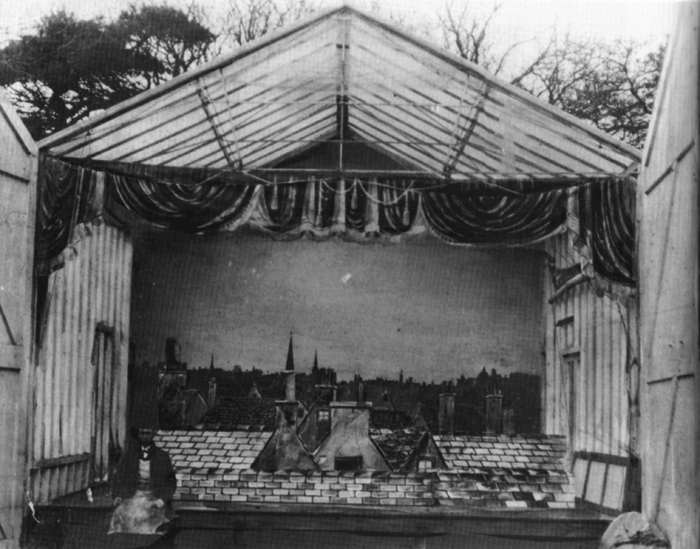
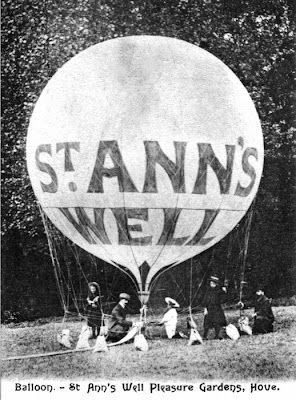
However, some filmmakers, like George Albert Smith and James Williamson, began to transition into other parts of the film business which eventually overtook their directing efforts. Already in 1898, the same year that he made Santa Claus and Photographing a Ghost, Smith was also processing and printing film for fellow filmmakers, like James Williamson, and for Charles Urban’s Warwick Trading Company, among numerous others. While Smith’s success in film during this period meant that in late 1898 and early 1889, his films were presented alongside Georges Méliès’ at the Alhambra Theatre in Brighton; Smith’s simultaneous success with the Warwick Trading Company meant that by 1900 the company helped to finance the construction of a film studio at St. Ann’s Well Gardens (Fisher, Brighton & Hove from the dawn of the cinema, 2012).
Offered a two-year contract by the Warwick Trading Company, Smith was described that year in the Warwick Trading Company’s catalogue as “Manager of the Brighton Film Works of the Warwick Trading Company”. This is also the year that Smith produced, among other films, As Seen Through a Telescope and Grandma’s Reading Glass.
In January of 1901, Queen Victoria of the United Kingdom died, and Britain entered the Edwardian era. The coronation of Edward VII and his Queen Consort, Alexandra, took place over a year and a half after Queen Victoria’s death, on August 9, 1902, at Westminster Abbey. This would be the first coronation in over 60 years. For royal context, the new king, Edward VII, the son of Queen Victoria, was the grandfather of George VI, who was portrayed onscreen by Colin Firth in The King’s Speech, and of the scandalous Edward VIII, known after his abdication as the Duke of Windsor. And for those not up on their modern British royal family history, that means Edward VII was the late Queen Elizabeth II’s great-grandfather.
Though the official website of the British royal family claims that “The coronation of the new Sovereign follows some months after his or her accession, following a period of mourning and as a result of the enormous amount of preparation required to organise the ceremony,” (The Royal Household, 2022) I see no instance of a coronation taking place less than a year after the previous monarch’s death since the coronation of George IV in 1821, which took place a year and a half after he acceded to the throne—though George VI did hold his coronation within a year of his brother’s abdication.

As in modern times, the British Royal family of the Victorian and Edwardian eras seem to have had innate understanding of the power of the media and, as her Diamond Jubilee approached in 1897, Queen Victoria showed an astute understanding of public image and the power of photography and film. For example, for her “official portrait”, she chose a photograph taken four years earlier. While Queen Victoria required the name of the photographer be cited whenever the photograph was used, she also had the copyright removed—allowing her image to be put on an infinite variety of products and items for mass consumption, “from biscuit tins to tea towels”, and ensuring her image was ubiquitous (Merck, ed., 2016).
On June 22, 1897, three million people gathered to watch the Queen’s procession, with cameramen placed at various points on the six-mile route to fully capture the event. Robert W. Paul, the inventor of the theatrograph, which we briefly discussed in episode 1 as being the first motion picture camera bought by Méliès, was one of the many filmmakers present at the Jubilee: “Large sums were paid for suitable camera positions, several of which were secured for my operators. I myself operated a camera perched on a narrow ledge in the Church yard” (Merck, ed., 2016).
Queen Victoria's Diamond Jubilee (1897) dir. Unknown
Such films are known as actualities and, according to the late film historian, John Barnes: “These films complimented news coverage of the events represented, and provided a visual corollary to the descriptions in the popular press. Like the panoramas, dioramas, and wax museums of the late nineteenth century, they were not so much sources of news in themselves as representations of current events already familiar from other sources” (Barnes, The Beginnings of the Cinema in England, 1894-1901: Volume 5. , 1996).
The response from the crowd upon seeing the Queen during her procession was surprising to and overwhelming for her, as she wrote in her diary: “No-one ever I believe, has met with such an ovation as was given to me, passing through those 6 miles of streets, including Constitution Hill. The crowds were quite indescribable, & their enthusiasm truly marvelous & deeply touching. The cheering was quite deafening, & every face seemed to be filled with real joy. I was much moved & gratified” (Merck, ed., 2016). Films of the Queen’s Jubilee proved to be very popular and profitable for film producers and distributors and became a focal point of many film exhibitions.
The effect of the Jubilee being filmed and exhibited was to allow those who were normally unable to witness such an event, such as the disabled and/or the poor, and particularly those living in remote locations, to experience an occasion of national importance and afford them a sense of participation and national identity. Fairground exhibitors, which catered to the poor in rural and/or industrial areas, found film of the Jubilee to be so popular that they were forced to increase the number of showings. The late film historian, John Barnes, states “[Exhibition sites] varied in scale from grand Bioscope Shows in tents capable of holding as many as 500 spectators, to peep-show street cinematographes with eyepieces for twenty people” (Barnes, The Beginnings of the Cinema in England, 1894-1901: Volume 5. , 1996).
Even this early in film’s history, royal patronages were being sought by film producers and partnerships for exclusive access and rights were already being formed. British inventor, William Dickson, who had invented the kinetoscope for Edison, had helped to form the American Mutoscope and Biograph Company in 1895, before returning to Britain two years later to work for its British branch. Approximately a decade later, the company would be known as the simpler Biograph Company, and is remembered as the studio for whom D.W. Griffith, Mary Pickford, and Lillian Gish, among others, worked. On the Prince of Wales receiving the honor of the Order of Bath, a banquet was held, after which the British Mutoscope and Biograph Company was invited to St. James Palace to present an exhibition of films, including parts of the Queen’s Diamond Jubilee procession.
According to film scholar, Ian Christie:
“The British Mutoscope and Biograph … appears to have adopted a deliberate policy of courting royal relationships, possibly in order to counteract the dubious reputation of its Mutoscope subjects, which often featured titillating images of glamorous women. In the summer of 1897, their record of Afternoon Tea in the Gardens of Clarence House showed three generations of the royal family at a garden party with what Richard Brown and Barry Anthony term ‘startling informality’. British Bioscope’s relationship with the royal family continued to bear fruit after the St James’s Palace showing. They filmed the Queen laying the foundation stone of the Victoria and Albert Museum on 17 May 1899, while a Biograph show was given at Sandringham on 29 June. And in the summer of 1900, Biograph filmed what is probably the most important of the early ‘intimate’ royal films, [Children of the Royal Family of England], which showed ‘our future king at play’ – namely Prince Edward of York, later Edward VIII. This two-part film, made over two mornings, was a major success for the company, becoming an extremely popular item in Biograph programmes at the Palace Theatre, and later on their home-viewing system, the Kinora. And Biograph’s relationship with the future king, Prince Albert, soon to be Edward VII, would continue, as they filmed many events throughout his reign” (Merck, ed., 2016).
This presented film producers from competing companies with a problem, as the British Mutoscope and Biograph Company had exclusive rights to film the coronation inside Westminster Abbey.
The answer as to how to compete with British Mutoscope and Biograph: a reconstructed actuality, also known as a reconstructed newsreel; like what we know today as a docudrama.
In 1902, Urban’s success with the Warwick Trading Company led him to open a Paris branch. Again, Urban was already associated with the Montreuil-based George Méliès, as the English distributor of his films. George Méliès had been creating reconstructed actualities since 1897, with a series based on the Dreyfus Affair, which were sympathetic in its presentation of Dreyfus, being among Méliès’ best known.
Méliès’ sympathetic portrayal served as powerful propaganda, as many actualities and reconstructed actualities did, and as many films, such as Casablanca, still do—though it wasn’t the content of the images as much the context of the exhibition that were propagandistic. Nonetheless, so divisive was public opinion regarding Dreyfus that fights broke out in the audience during exhibitions of Méliès’ films. The French Government ended up banning Méliès’ film series, as well as one produced by Pathé, and hindered its distribution internationally—though probably more to protect its own reputation amid national and international outcry and charges of antisemitism (Barnes, The Beginnings of the Cinema in England, 1894-1901: Volume 5., 1996).
Urban tackled the challenge of competing with the British Mutoscope and Biograph by commissioning the great Méliès to create a reconstructed actuality of Edward VII’s upcoming coronation. According to Dr. Richard Abel, Professor Emeritus of International Cinema and Media Studies at the University of Michigan, The Coronation of Edward VII “was quite different from L’Affaire Dreyfus and much closer to the tableau vivant style that would soon characterize the historical film” (Abel, 1998).
The Coronation of Edward VII (1902) dir. Georges Méliès
While Méliès is famous today for his fanciful sets and creative details, historical accuracy was of the utmost importance to compete with the Mutoscope and Biograph’s footage of the actual coronation. Indeed, Méliès and his co-producer were so determined to create an authentic representation of the event that they even visited Westminster Abbey, which Méliès then attempted to faithfully recreate at his own greenhouse-like studio in Montreuil. After all, if Méliès could create military reenactments of the Greco-Turkish war in a Parisian garden (Barnes, The Beginnings of the Cinema in England, 1894-1901: Volume 5.,1996), he could certainly recreate Westminster Abbey within the confines of his studio.
Additionally, Urban insisted on the use of his own camera, the Bioscope, during the production of this film. As this was a pre-enactment, having been filmed prior to the actual coronation, to be printed and shipped to exhibitors in time for its premiere on the date of the coronation on the 26th of June, Méliès had to depend on the ritual of the ceremony to anticipate the actions of the British royals. Ever the world of make-believe that filmmaking is, the actor playing the new king was a washroom attendant, cast for his supposed likeliness to Edward VII (Abel, 1998). According to multiple sources, including former editor of Screen Digest, David Fisher and film critic and author David Robinson, George Albert Smith worked with Méliès on this film. Indeed, Dr. Frank Gray states that Méliès and Smith were acquaintances who corresponded with one another during this period (Gray, George Albert Smith, 2022).
According to multiple sources, including former editor of Screen Digest, David Fisher and film critic and author David Robinson, George Albert Smith worked with Méliès on this film. Indeed, Dr. Frank Gray states that Méliès and Smith were acquaintances who corresponded with one another during this period. (Gray, George Albert Smith, 2022)
But I am unable to clarify exactly what function Smith served in the making this film, especially considering that, at this point in his life, Smith was a successful businessman, showman, and filmmaker with his own studio and lab. However, as this film was an international coproduction commissioned by Urban on behalf of the Warwick Trading Company, I’m guessing that Smith was involved in relation to his role as the manager of the Brighton Film Works of the Warwick Trading Company, which is how Smith was listed in the Warwick Trading Company’s catalogue. I speculate that, perhaps, Smith acted as a representative of Urban and the company in this international coproduction and functioned in an intermediary role—a role that would have benefitted from Smith and Méliès’ acquaintanceship. As Urban even wanted his own camera used in the filming, perhaps Smith monitored the production and assisted with the use of Urban’s film equipment. This would also allow an Englishman to monitor for cultural considerations.
Whatever the case may be, the film was ready for exhibition by the coronation’s date on the 26th of June, when, three days before the coronation was to occur and, therefore, the film’s premiere, an announcement was made by the Palace that the coronation was being delayed—the 60-year-old Edward VII had been stricken with appendicitis. The coronation finally occurred a month and a half later, on the 9th of August, with Méliès’ film premiering that same day, headlining at the Alhambra Music Hall in Leicester Square in London. (Christie, 2016) Urban bookended the film with actual footage of the royal coach’s arrival and departure, to complete the pseudo-newsreel quality. (Librach, 2022)
Unused footage of the Coronation of Edward VII procession (1902)
An immediate hit, Méliès and Urban’s The Coronation of Edward VII made the rounds on the Empire Palace music hall circuit in England, before embarking on a world tour as ostensibly the first royal documentary. (Abel, 1998) According to Ian Christie: “Urban’s investment in this coverage, and that of the other companies, confirm that the advent of the photographic image, both still and moving, had made the British monarchy a highly marketable spectacle. (Christie, 2016)
Beyond making The Coronation of Edward VII, 1902 was a peak year for Méliès and Smith, with Smith also producing Mary Jane’s Mishap, while Méliès produced his well-remembered and beloved A Trip to the Moon. But by the following year, events were beginning to transpire that would affect the future of not only Méliès, Smith, and Urban, but of filmmaking itself.
Join us for episode 10 for the conclusion to this 6-part series on Spiritualism and filmmaker, G.A. Smith
Please subscribe to Rhapsody in 35MM wherever you listen to your podcasts. Also, subscribe to this website so you will be alerted to new postings such as this. Please make sure to follow us on the social media platform of your choice -- the links can be found on this website. Please make sure to rate us and comment on Apple podcasts, or wherever you listen to podcasts. Until next time!
Sources
Abel, R. (1998). The Cine Goes to Town: French Cinema, 1896-1914, Updated and Expanded Edition. Berkeley: University of California Press.
ACMI. (2022). George Albert Smith. Retrieved from ACMI: https://www.acmi.net.au/creators/45307--george-albert-smith/
Amberley Publishing. (2020). Judy Middleton. Retrieved from Amberley Publishing: https://www.amberley-books.com/author-community-main-page/m/community-judy-middleton.html
Barnes, J. (1996). The Beginnings of the Cinema in England, 1894-1901: Volume 5. . Exeter: University of Exeter Press, 1996.
Barnes, J. (2022). Alfred Darling. Retrieved from Who's Who of Victorian Cinema: https://www.victorian-cinema.net/darling.php
British Pathe. (2022). 1890s Traffic Scenes. Retrieved from British Pathe: https://www.britishpathe.com/gallery/1890s-traffic/5
Brooke, M. (2014). Attack On a China Mission (1900). Retrieved from BFI Screen Online: http://www.screenonline.org.uk/film/id/520615/index.html
Brooke, M. (2014). Big Swallow, The (1901). Retrieved from BFI Screen Online: http://www.screenonline.org.uk/film/id/444628/index.html
Brooke, M. (2014). Grandma's Reading Glass (1900). Retrieved from BFI Screen Online: http://www.screenonline.org.uk/film/id/443114/index.html
Brooke, M. (2014). Santa Claus (1898). Retrieved from BFI Screen Online: http://www.screenonline.org.uk/film/id/725468/
Brown, S. (2014). Hepworth, Cecil (1874-1953). Retrieved from BFI Screen Online: http://www.screenonline.org.uk/people/id/450004/
Christie, I. (2016). The British Monarchy On Screen. Manchester: Manchester University Press.
Christie's. (2022). Biokam camera no. 234. Retrieved from Christie's: https://www.christies.com/en/lot/lot-4320152
Clarens, C. (1997). An Illustrated History Of Horror And Science-fiction Films: The Classic Era, 1895-1967. Cambridge: Da Capo Press.
Dissanayake, W., & K. Gokulsing, e. (2013). The Routledge Handbook of Indian Cinemas. London: Routledge.
Fairservice, D. (2001). Film Editing - History, Theory and Practice: Looking at the Invisible. Manchester: Manchester University Press.
Fisher, D. (2009, July 13). Films made in Brighton & Hove: As Seen Through a Telescope. Retrieved from Brighton On Film: https://web.archive.org/web/20120322002732/http://www.terramedia.co.uk/brighton/brighton_films_telescope.htm
Fisher, D. (2012). Brighton & Hove from the dawn of the cinema. Retrieved from Brighton & Hove, film and cinema: https://web.archive.org/web/20150811070923/http://brightonfilm.com/brighton_chronology.htm
Fisher, D. (2012). Cinema-by-Sea: Film and Cinema in Brighton & Hove Since 1896. Brighton: Terra Media Ltd.
Fisher, D. (2015). Films made in the Brighton & Hove area: The silent era. Retrieved from Brighton History: https://www.brightonhistory.org.uk/film/films/films_made_in_brighton_silent.htm
Fisher, D. (2022, June 28). The history. Retrieved from Brighton & Hove, film and cinema: https://www.brightonhistory.org.uk/film/film_history1.html
Gerson, E. (2003). X-ray Mania: The "X-Ray" in Advertising, Circa 1895. Retrieved from Abstract Archives of the RSNA, 2003: http://archive.rsna.org/2003/3300013.html
Gerson, E. S. (2004). Scenes from the Past: X-ray Mania: The X Ray in Advertising, Circa 1895. Retrieved from RadioGraphics: https://pubs.rsna.org/doi/full/10.1148/rg.242035157
Gray, F. (1998). Smith the Showman: The Early Years of George Albert Smith. Film History, 8-20.
Gray, F. (2014). Smith, G.A. (1864-1959). Retrieved from BFI Screen Online: http://www.screenonline.org.uk/people/id/449633/index.html
Gray, F. (2022). George Albert Smith. Retrieved from Who's Who of Victorian Cinema: https://www.victorian-cinema.net/gasmith
Groth, H. (2013). Moving Images: Nineteenth-Century Reading and Screen Practices. Edinburgh: Edinburgh University Press.
Guiness Book of World Records. (2022). Earliest surviving use of double exposure in a movie. Retrieved from Guiness Book of World Records: https://www.guinnessworldrecords.com/world-records/107460-earliest-surviving-use-of-double-exposure-in-a-movie
Henry, H., & Impey, C. (2013). Dreams of Other Worlds: The Amazing Story of Unmanned Space Exploration. Princeton: Princeton University Press.
Leeder, M. (2017). The Modern Supernatural and the Beginnings of Cinema. London: Palgrave Macmillan.
Librach, R. S. (2022). The Illustrated Guide to Early Cinema. Retrieved from Cinematheque Froncaise: http://cinemathequefroncaise.com
Mandy Merck, e. (2016). The British Monarchy On Screen. Manchester: Manchester University Press.
Middleton, J. (2015). Hove in the Past. Retrieved from St. Ann's Well Garden, Hove: Judy Middleton, http://hovehistory.blogspot.com/2015/04/st-anns-well-gardens-hove.html
National Media Museum. (2022). Beale's Choreutoscope, c 1890. Retrieved from Bridgeman Images: https://www.bridgemanimages.com/en/noartistknown/beale-s-choreutoscope-c-1890/object/asset/5062336
Nobel Prize Outreach. (2022). Wilhelm Conrad Röntgen – Biographical. Retrieved from NobelPrize.org: https://www.nobelprize.org/prizes/physics/1901/rontgen/biographical/
Rajadhyaksha, A. (1986). Neo-Traditionalism: Film as Popular Art in India. Framework: The Journal of Cinema and Media, 20-67.
Robinson, D. (2002). Funny Ladies: The Comediennes of the Silent Screen. Retrieved from La Cineteca del Friuili: http://www.cinetecadelfriuli.org/gcm/ed_precedenti/edizione2002/Funny_Ladies.html#introduction.html
Rutgers. (2022). Maguire & Baucus. Retrieved from Rutgers School of Arts and Sciences: https://edison.rutgers.edu/life-of-edison/companies/company-details/motion-pictures/maguire-baucus
Secord, J. A. (2002). Quick and Magical Shaper of Science. Science, 1648-1649.
The Editors of Encyclopedia Britannica. (2022). Wilhelm Conrad Röntgen. Retrieved from Britannica: https://www.britannica.com/biography/Wilhelm-Rontgen
The Kodak Collection at the National Media Museum, Bradford. (2022). Williamson 35mm cine camera. Retrieved from Science Museum Group: https://collection.sciencemuseumgroup.org.uk/objects/co8209464/williamson-35mm-cine-camera-cine-camera
The Regency Society. (2022). Ivy Lodge. Retrieved from The James Gray Collection: http://regencysociety-jamesgray.com/volume12/source/jg_12_188.html
The Royal Household. (2022). Coronation. Retrieved from Official Website of the Royal Family: https://www.royal.uk/coronation

Comments