SEASON 1: The Horror Genre, George Albert Smith, and Spiritualism
In Season 1, we begin our deep dive into the horror genre by discussing what, exactly, makes a horror film. We analyze what is, arguably, the first horror film, George Melies' 1896 film Le Manoir du Diable (The House of the Devil). And, we look at English director George Albert Smith's contributions to film history and his link to the Victorian spiritualism movement through the Society for Psychical Research.

S01E01: REMIXED - What’s in a Name? The Etymology and Science of Horror
Horror is a genre that reflects the darkest aspects of human nature, history, and imagination, mirroring societal fears born of violence, war, scientific ambition, and anxieties about the future, while also confronting the inner duality of the human soul. From revolutionary atrocities and Frankenstein’s cautionary tale of unchecked progress to atomic-age monsters shaped by nuclear terror, horror repeatedly transforms real-world anxieties into symbolic narratives. Rooted etymologically in physical reactions like shuddering, bristling, and fear—captured in the Greek concept of phrikē and the Latin horrere—horror engages our bodies and minds through controlled fear, triggering adrenaline while keeping us safe. Psychologically and biologically, it functions as both a training ground for danger and a window into the unknown, satisfying curiosity about taboo, violence, and the shadows of human behavior. Audience responses vary widely based on individual taste, disgust sensitivity, biology, and social conditioning, particularly regarding graphic violence, yet the enduring appeal of horror suggests a deep fascination with seeing our darkest impulses reflected back to us, revealing as much about who we are as about what we fear.

S01E02: REMIXED - A New Dimension in Terror: Tropes and Techniques
This episode explores what distinguishes horror from adjacent genres like the thriller by examining the specific cinematic techniques and thematic elements that define it, focusing on how film uniquely manipulates image, sound, perspective, and narrative to create sustained unease and fear. Horror relies on the strategic withholding of information through lighting, shadow, framing, camera angles, depth of field, editing, and point of view to heighten tension and suggest unseen threats, while sound—both diegetic and non-diegetic, including dissonant music, nonlinear noise, and low-frequency tones—works in tandem with visuals to provoke physiological and emotional discomfort. These formal techniques support recurring horror themes such as the supernatural, monstrosity, duality, obsession, revenge, transformation, isolation, and humanity’s desire to control nature or transgress moral boundaries. Whether through tragic victims, invasive monsters, psychological killers, or forces rooted in culture, religion, or science, horror consistently seeks not just to thrill, but to disturb—using atmosphere, ambiguity, and fear itself as its defining currency.

S01E03: REMIXED - Sunday in the Dark with Georges – Melies’ The House of the Devil
Ep. 3 traces humanity’s long fascination with horror and spectacle—from ancient theatre, folklore, and public executions to phantasmagoria and magic lantern shows—and argues that these pre-cinematic forms directly shaped early horror film, culminating in Georges Méliès’ 1896 short Le Manoir du Diable (The House of the Devil), often cited as the first horror film. Rooted in Méliès’ background as a stage magician and illusionist, the film draws on Faustian literature and theatrical trickery, using bats, demons, witches, skeletons, transformations, and magical effects to frighten audiences in a safe, entertaining context, much like earlier spectacles. While some scholars have interpreted the character of Mephistopheles as the first cinematic vampire due to bat imagery, hypnotic power, and defeat by a crucifix, the episode contends that the character is clearly a demon—an agent of the devil—consistent with Goethe and Marlowe’s Faust and with the film’s title, which explicitly references the devil. Nevertheless, because associations between bats and vampires already existed in popular culture before Bram Stoker’s Dracula (1897), and because Méliès’ film was screened in London while Stoker was active in theatre there, the episode suggests that The House of the Devil may have influenced Stoker’s vampire mythology, even if it is not itself a vampire film, illustrating how early cinematic horror helped solidify tropes that later became central to the genre.

S01E04: REMIXED - From Magic Tricks to Trick Films: The Transition of Georges Meliese
Although horror may seem easy to identify, early cinema complicates genre classification because it lacked many formal tools—such as sound, editing techniques, close-ups, and artificial lighting—while emerging alongside an already well-established literary and theatrical tradition of horror and the supernatural. Using Georges Méliès’ work as a case study, the episode argues that many early “magical,” “phantasmagoric,” or “trick” films are often misidentified as horror simply because they feature dark imagery like skeletons, bugs, decapitation, or death, when in fact their tone, mood, and character reactions signal comedy or spectacle rather than fear. Drawing on Ann Radcliffe’s distinction between terror and horror, the author emphasizes that genre depends not on subject matter alone but on intent, atmosphere, and audience identification with characters—elements communicated through performance and tone rather than narrative complexity in early film. Méliès’ trick films such as The Vanishing Lady, A Terrible Night, and The Four Troublesome Heads function primarily as spectacle or comic demonstrations of cinematic illusion, with the “trick” itself forming the narrative arc and no real emotional stakes for characters. Similarly, later films like Mary Jane’s Mishap (1903), despite involving death and ghosts, use exaggerated performance and gallows humor to provoke laughter rather than fear. Ultimately, the episode contends that early horror should be defined by a clear intention to frighten, not merely by the presence of macabre imagery, making genre classification in early cinema inherently subjective but still discernible through tone and audience cues.

S01E05: REMIXED - Mesmerizing! Spiritualism and the Beginnings of Director G.A. Smith
The episode traces how Victorian-era beliefs in mesmerism, spiritualism, and psychical research—emerging from a period when science, medicine, religion, and spectacle were not yet clearly separated—profoundly shaped popular culture and early horror cinema. Beginning with Franz Anton Mesmer’s theory of animal magnetism and its highly theatrical, trance-inducing treatments, the episode shows how mesmerism blurred the line between scientific inquiry, performance, and charlatanism, influencing the development of hypnotism and modern psychology while captivating the public imagination. Spiritualism, imported from the United States through figures like the Fox Sisters and fueled by mass death during the American Civil War, offered comfort, challenged religious orthodoxies threatened by Darwinism, and aligned itself with progressive causes such as abolition and women’s rights, even as it was exploited by frauds like spirit photographers. Intellectuals and scientists—including Alfred Russel Wallace and members of the Society for Psychical Research—debated the legitimacy of these phenomena, splitting believers from skeptics and exposing both genuine inquiry and spectacular deception. Within this cultural milieu, early filmmakers such as George Albert Smith, himself deeply involved in mesmerism, hypnotism, and psychical circles, translated spiritualist imagery—ghosts, rapping spirits, mind control, and apparitions modeled on spirit photography—into cinema, often comedically rather than horrifically, yet establishing visual and narrative conventions that would later define horror. Ultimately, the episode argues that Victorian struggles over belief, authority, class, gender, and scientific legitimacy created the conceptual and aesthetic foundations for the horror genre long before it was formally recognized as such.

S01E06: REMIXED - Murder Mystery: G. A. Smith and the Society for Psychical Research
This episode examines the late-19th-century Society for Psychical Research through its key figures—Henry Sidgwick, Frank Podmore, Frederic W.H. Myers, Edmund Gurney, and future filmmaker G.A. Smith—focusing on the intersection of psychical research, early psychology, personal ambition, and scandal. It revisits Smith’s early career as a mesmerist and telepath whose performances with journalist Douglas Blackburn led to paid work and prestige within the Society, before Blackburn’s flawed 1911 confession cast doubt on their experiments and the Society’s credibility. Central to this controversy are Podmore’s belief in telepathy despite his skepticism toward mediums, Myers’ influential but controversial theories of the subliminal mind and survival after death, and Gurney’s crucial contributions to psychology and hallucination research, later marginalized due to psychology’s rejection of its occult roots. The episode culminates in the mysterious 1888 death of Gurney following the critical failure of Phantasms of the Living, exploring competing theories of suicide versus accidental chloroform overdose amid professional humiliation, personal betrayal, and mental illness. Despite internal conflicts and public criticism, the Society continued to shape early psychology, while Smith—after Gurney’s death and his own departure from the Society—returned to theatrical spectacle and soon helped pioneer cinema, carrying the intellectual, ethical, and imaginative tensions of psychical research into the emerging medium of film.
LISTEN

S01E07: REMIXED: A New World Dawning
Episode 7 explains how the Victorian-era fascination with Spiritualism, science, and the supernatural influenced entertainment, early psychology, and the horror genre. Social conditions such as the American Civil War, high infant mortality, and popular Gothic literature—especially works by Edgar Allan Poe and Sheridan Le Fanu—helped fuel widespread interest in communicating with the dead, inspiring phenomena like spirit photography and stage illusions. One of the most famous technological spectacles was Pepper’s Ghost, popularized by John Henry Pepper from an invention by Henry Dircks, which used angled glass and lighting to create realistic ghostly apparitions on stage, influencing theater, film, and even modern attractions like The Haunted Mansion. At the same time, intellectual interest in the paranormal led to the founding of the Society for Psychical Research, whose members—including figures like William James and Frederic W. H. Myers—studied hypnosis, hallucinations, and telepathy, contributing to the emerging field of psychology. These cultural currents also shaped early filmmakers such as George Albert Smith, whose background in mesmerism, stage performance, and visual spectacle—along with the work of collaborators like actress Laura Bayley—helped bridge Victorian theatrical illusion, psychical research, and the development of cinematic storytelling.
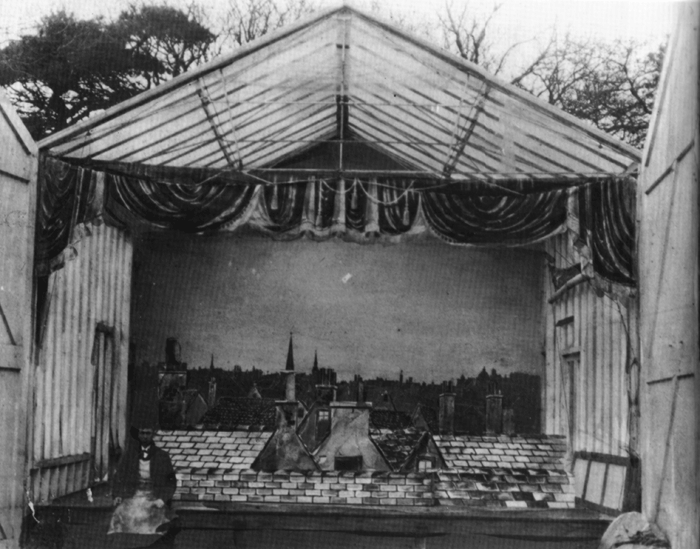
S01E08: REMIXED: Photographing a Ghost: G. A. Smith at St. Ann’s Well Gardens
In 1896, George Albert Smith experienced a pivotal turning point after seeing one of the first projected film programs in Britain by the Lumière Brothers at the Empire Theatre. Inspired, he purchased a camera from engineer Alfred Darling and soon converted part of his amusement grounds at St. Ann’s Well Gardens into a film studio, producing dozens of short films while experimenting with the new medium’s possibilities. Drawing on his background in magic lantern shows and stage entertainment, Smith pioneered several early cinematic techniques—such as close-ups, point-of-view shots, inserts, action continuity, double exposure, and early parallel editing—in films like Grandma's Reading Glass, As Seen Through a Telescope, A Kiss in the Tunnel, and Santa Claus. His trick films also reflected contemporary fascinations with science and the supernatural, parodying spirit photography and the craze following Wilhelm Conrad Röntgen’s discovery of X-rays in the comic short The X-Rays. Working alongside performers such as his wife Laura Bayley and contemporaries like fellow Brighton pioneer James Williamson, Smith helped make Brighton and Hove a center of early cinematic innovation, contributing key developments in film narrative and editing during the medium’s formative years.

S01E09: REMIXED: The Brighton School and the Intersection of Melies, Smith, and Phalke
This episode examines the early development of cinema through the work of Brighton-based filmmakers George Albert Smith and James Williamson—members of what later historians called the “Brighton School”—and explores how many early filmmakers, including Georges Méliès and Dadasaheb Phalke, came from backgrounds in magic, stage entertainment, and magic-lantern shows. The discussion highlights Smith’s topical trick film The X-Rays, inspired by the public craze following Wilhelm Conrad Röntgen’s discovery of X-rays, and Williamson’s increasingly ambitious narrative filmmaking such as Attack on a China Mission. Central to this emerging industry was American-born producer and distributor Charles Urban, whose Warwick Trading Company distributed films by Smith, Williamson, and Méliès while helping shift cinema from pure spectacle toward narrative storytelling. The episode culminates with Urban’s collaboration with Méliès on the reconstructed news film The Coronation of Edward VII, a staged “actuality” created to compete with exclusive footage of the real coronation at Westminster Abbey, illustrating both the growing commercial power of film and the transition from trick-film attractions to more sophisticated narrative and documentary forms at the turn of the 20th century.

S01E10: REMIXED: Murder Mystery Solved: The Final Days of Méliès and G. A. Smith
This episode traces a turbulent period in early cinema beginning around 1903, when the successes of filmmakers like Georges Méliès and George Albert Smith were threatened by widespread film piracy, weak copyright protections, and shifting industry power. Méliès’ films—distributed internationally through businessman Charles Urban—were frequently exploited or pirated by companies such as Lubin Manufacturing Company and Edison Manufacturing Company, reflecting the lawless commercial environment of early filmmaking before motion pictures gained copyright protection in 1912. At the same time, Smith left narrative filmmaking to pursue color cinematography after the death of pioneer Edward Raymond Turner, eventually developing the two-color process later commercialized as Kinemacolor, though business disputes with Urban and the marginalization of Turner’s widow complicated its success. The narrative also follows the personal tragedies surrounding members of the Society for Psychical Research—particularly investigator Frank Podmore, whose career and reputation collapsed amid scandal before his mysterious death in 1910. Ultimately, while technological innovations like Kinemacolor reshaped the medium, many early pioneers struggled with exploitation, legal uncertainty, and changing audience tastes; Méliès himself went bankrupt and fell into obscurity before later recognition, while Smith lived long enough to witness the mature film industry that his generation helped create.