Ep. 8: REMIXED - Photographing a Ghost: G. A. Smith at St. Ann’s Well Gardens
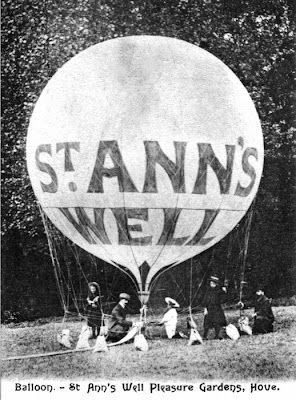
As we discussed at the end of the previous episode, by 1892 George Albert Smith had transitioned away from his career working as a researcher, investigator, and secretary for the Society of Psychical Research, and had returned to his theatrical roots, leasing the pleasure garden, St. Ann’s Well Gardens in Hove, part of the city of Brighton and Hove in East Sussex, to run as public entertainment. Included in Smith’s pleasure and amusement garden were hot air balloons, parachutists, jugglers, trapeze artists, and magic lantern shows. But fate once again stepped in…
It was 1896, and as suddenly and unexpectedly as his meeting Douglas Blackburn and being spotted by Frank Podmore of the Society for Psychical Research had altered his life 14 years prior, George Albert Smith underwent another life-changing event: he went to the Empire Theatre in Leicester Square, which was exhibiting the first commercial theatrical showings of a projected film in the UK—a program exhibition by the Lumiere Brothers (British Pathe, 2022).
That same year, Smith bought his first film camera from Brighton-based engineer, Alfred Darling, who specialized in producing cinematographic equipment (Barnes, 2022). According to film editor and professor, Don Fairservice, Smith also built his own film camera during this same year (Fairservice, 2001). By the next year, in 1897, he began the process of turning a portion of his leased property into a film studio, repurposing part of the Pump House for a laboratory. In May of 1897, an article in the Hove Echo reported regarding the subject of “animated photographs”: “[Mr.] Smith was discovered near his laboratory, and on learning his visitor’s errand, immediately asked him into that mysterious chamber. A glance around the apartment was quite sufficient to impress one with the fact that the various appliances were there for practical use and not for show. The mechanical contrivances, baths containing [solutions, etc.,] all served to impress the uninitiated with a certain awe inseparable from that which is not understood” (Middleton J. , 2015).
G. A. Smith's studio in St. Ann's Well Gardens, set up for the brief rooftop scene toward the end of Mary Jane's Mishap (1903), as seen in the still on the right. Both photos are Public Domain. Taken from Brighton & Hove, film and cinema.
In the article, Smith discussed his process and the technical details involved, explaining that, as good sunlight was paramount for proper lighting, he shot most of his films in the spring and summer (Middleton J. , 2015). According to Judy Middleton, a Sussex historian:
“Smith explained to the reporter that the easiest rate for taking photographs was 20 per second, which came to around 1,200 a minute, the standard rate at which they worked. … Every complete film was composed of around 25 yards of film with the photographs measuring about one inch across (the size of a postage stamp) with perforations on either side. It cost one sovereign every time a negative was taken and of course there were yards of wasted material. The images were thrown upon a sheet in the same way as a magic lantern operated” (Middleton J. , 2015).
In the promotional booklet Smith produced that year to promote his pleasure and amusement garden, he advertised: “High Class Lecture Entertainments with Magnificent Lime-Light Scenery and Beautiful Dioramic Effects". Additional attractions included: "Cinematographe. Displays of Animated Photography, Interesting and Sensational Moving Pictures (Gray, 2014). According to the British Film Institute, this illustrates that the relationship between film, lantern slides, and lantern projection, including the combining of still and moving images in a performance, held great interest for Smith. Like Méliès, Smith’s background in entertainment and his experience with magic lantern performances informed his filmmaking, providing a foundation on which to build and for which to explore this new medium. For example, Smith also converted into film the popular stories which he had already adapted into sets of lantern slides (Gray, 2014).
Smith would produce 31 short films that year, including the first football match, also known as soccer, which he had complained was difficult to film, as the players soon ran beyond the range of the frame of the camera (Middleton J. , 2015). During this time, Smith explored and developed many film innovations. Indeed, according to film editor and professor, Don Fairservice: “on the evidence that exists, it seems that most of the pioneering development in the structure and editing of early films took place in Britain. … There was a conservatism that existed in the United States which seems to have been based on a principle that if a product was selling well and customers were satisfied, why alter it?” (Fairservice, 2001)
Among Smith’s early comedy shorts were a series of so-called “facials”, which are short films showing in medium closeup an individual’s facial expressions and reactions for the purpose of comedy and entertainment. Most are a simple one shot, medium closeup of a slightly evolving action; for example, a man drinking beer and gradually getting drunker, causing him to laugh and make rude gestures, as in 1897’s Old Man Drinking a Glass of Beer. According to film critic and historian, David Robinson, Smith’s records indicate that his wife, Laura Bayley, was involved directing some of the “facials” credited to her husband, including the Biokam “facial,” “Letty Limelight in Her Hair” (Robinson, 2002).
Old Man Drinking a Glass of Beer (1897) dir. George Albert Smith
Biokam, patented in 1898, was a complicated camera: part projector, printer, enlarger, reverser, snapshot camera, and cinematograph. The camera was made by the Brighton-based engineer, Alfred Darling, from whom Smith bought his first camera, (Christie's, 2022) possibly the Biokam used for this film. The Biokam was sold to the Warwick Trading Company, for whom G.A. Smith was processing commercial films (Science Museum Group, 2022).
But by 1900, Smith was progressing, including closeups, extreme closeups, inserted shots and point-of-view shots. An example of this can be seen in Smith’s three-shot comedy, As Seen Through a Telescope, where a man is shown looking through a telescope. The telescope is the means by which Smith shows the audience what the man with the telescope is viewing. This is an early example of a point-of-view shot, which is a shot that allows the audience to see what a specific character is looking at; therefore, the audience is seeing the shot from a specific character’s point of view.
As Seen Through the Telescope (1900) dir. George Albert Smith
The man with the telescope spies a gentleman walking his bike with a lady on the road. When the gentleman stops to fix the lady’s boot laces, the man uses his telescope to spy the maybe not-so-gentlemanly man taking advantage of the situation and using it as an opportunity to caress the lady’s ankle. This part of the scene allows for the insertion of a closeup point-of-view shot, where the audience views through the telescope the man on the road fondling the lady’s ankle, though this closeup isn’t technically a point-of-view shot. A point-of-view shot, or at least in modern terms, keeps its continuity by ensuring the illusion of a spatial area is intact, regardless of the angle and number of shots within that spatial area. Here, the closeup of the foot is shot against an unmatched interior background, thus destroying that continuity.
To give the audience the impression of looking through an object, a masked vignette was utilized to frame the shot, which is a shield placed in front of the camera to temporarily change the shape and/or dimensions of the screen (Librach, 2022). The telescope magnifying the event allows for Smith’s use of the closeup shot. When the lady’s laces are fixed, the man puts down his telescope so as not to be caught, and the couple passes by the man with the telescope, with the ungentlemanly man knocking the man who spied on them off his chair. This film was shot outside the Furze Hill entrance to St. Ann’s Well Gardens in Hove (Fisher, 2009).
Grandma's Reading Glass (1900) dir. George Albert Smith
Another of this type of film is 1900’s Grandma’s Reading Glass. This film is about a boy, probably played by Smith’s son, using his grandmother’s magnifying glass to magnify various objects, such as a bird in a cage, a cat, the gears of a pocket watch, and an extreme closeup of Grandma, showing her eye rolling and darting around in a silly fashion. Both films use a narrative device to justify the closeups, with Grandma’s Reading Glass utilizing the magnifying glass to magnify objects, and As Seen Through a Telescope using a telescope. But the closeups are lacking in portraying appropriate dimensions, as there is little attempt to keep any realistic relationship between the sizes of the objects the boy sees through the reading glass. The objects are simply sized to fit inside the circular mask. As in his film, As Seen Through a Telescope, Smith again uses a masked vignette to frame the shot and give the audience the impression of looking through an object—in this case, the magnifying glass (Librach, 2022).
In both films, Smith merely juxtaposes “regular” view with “close” view. And in both films, this juxtaposition is the whole point, used as an attraction instead of as a narrative tool. This practice no doubt borrows from the magic lantern shows of Smith’s past (Librach, 2022).
But by 1903, Smith stopped using masks to frame point-of-view shots, which then allowed such inserts to better add to the overall narrative structure of the film, rather than distract from it. As Ronald S. Librach states, “These masks [served to] announce … point-of-view shots …. When they’re “announced”—when our attention is drawn to them as examples of the filmmaker’s manipulation of his medium—they function primarily as “attractions,” not as clarifications of narrative situations” (Librach, 2022).
Narratively, Grandma’s Reading Glass is weaker than As Seen Through a Telescope, which uses the insertion of the POV-shot, not only within the context of, but to further the story—while Grandma’s Reading Glass seems to be more of a spectacle trick film. However, according to the British Film Institute:
“Grandma's Reading Glass was one of the first films to cut between medium shot and point-of-view close-up, though the editing is no more ambitious than this - in fact, there is very little narrative to speak of besides the boy looking around for further objects to examine. … The close-ups themselves were simulated by photographing the relevant objects inside a black circular mask fixed in front of the camera lens, which also had the effect of creating a circular image that helped them stand out from the rest of the film” (Brooke, 2014).
Another innovation was Smith’s early use of action continuity. Popular with audiences of the time were “phantom rides”, which were tracking shots produced by mounting a camera on the front of a moving locomotive, which functioned as an attraction to take audiences through beautiful, exotic locales—sort of like travelogues. According to editor Don Fairservice:
“Phantom rides provided spectators with a privileged view of, often, exotic landscapes as the train on which the camera was mounted made its way trough attractive foreign locations. Whenever the train passed into a tunnel the camera operator would stop turning or alternatively the showman would cut the unexposed tunnel section out. Smith’s plan was that the showman could introduce an entertaining diversion that would maintain the continuity of the journey, obviate the need for a jump cut, and thereby enhance the spectator’s pleasure” (Fairservice, 2001).
View from an Engine Front - Barnstaple (1898) dir. Unknown A good example of a typical 'phantom ride" film popular at the time.
The scene Smith filmed for insertion amid this phantom ride, entitled The Kiss in the Tunnel, was a voyeuristic shot of the train’s interior where a gentleman woos and then kisses a lady, who may or may not be his wife. The tension and possible discomfort of seeing this short scene might have been titillating and/or discomforting to its Victorian audience, but luckily, such tension was relieved by the gentleman realizing he had sat on his hat, deflating the hat, the man’s ego, and the brief moment of intimacy. The gentleman and lady are played by George Albert Smith and his wife, Laura Bayley. According to Don Fairservice: “being inserted into a tracking shot, Smith’s version of the Kiss in the Tunnel takes the spectator on the journey with the couple …” (Fairservice, 2001).
A Kiss in the Tunnel (1899) dir. George Albert Smith
Smith probably had an idea of how to create action while maintaining continuity from one shot to the next because he explicitly referred to the cut from the kiss back to the phantom ride in his sales catalogue. But even with this alleged knowledge, the shot of the kiss was destined to function as an attraction unto itself rather than maintaining the illusion of spatial continuity (Librach, 2022).
Another example of Smith’s contributions to filmmaking is his film Santa Claus, from 1898, which is probably the oldest extant Christmas film. According to the British Film Institute, this film contains the earliest known example of parallel action. Parallel action is when two or more separate actions, often taking place in separate locations, are intercut to give the impression that they are taking place at the same time. They can also be used to illustrate a connection or contrast between said scenes, to create one total narrative.
Santa Claus (1898) dir. George Albert Smith
In Smith’s film, Santa Claus, two sleepy children on Christmas Eve are going to sleep. Dr. Frank Gray believes the children to be played by Smith and Bailey’s son and daughter (Gray, Smith the Showman: The Early Years of George Albert Smith, 1998). When the nanny turns off the lights, the background goes black, courtesy of a jump cut, to indicate the lack of light, while the children and the floor remain illuminated. When the lights go out, a superimposed image, shot inside of a circular mask, appears in the upper right of the frame, showing Santa Claus appearing on the rooftop and sliding down the chimney—this was created using double exposure. The parallel action occurs when we, the audience, see both the children sleeping inside the house, and Santa’s actions on the roof at the same time, as though these scenes are happening simultaneously—even though they are occurring in separate locations.
When he slides down the chimney, the scene in the circular mask disappears and Santa is seen arriving in the home to deliver presents. Before the children can awaken, Santa Claus then disappears via another jump cut (Brooke, Santa Claus (1898), 2014). Furthermore, according to the Guinness Book of World Records, the use of superimposition in this film marks Smith’s Santa Claus as the earliest surviving example of double exposure in a film (Guiness Book of World Records, 2022).
Indeed, according to ACMI, Australia’s national museum for the moving image, in 1897, Smith patented his own double-exposure system (ACMI, 2022). Smith may have utilized his own patented double exposure system in 1898, when producing The Mesmerist and Photographing a Ghost.
Both The Mesmerist and Photographing a Ghost see Smith creating films from a world with which he’d been intimately involved. After all, he had been a mesmerist, understood the public’s fascination with spiritualism, and was involved in the Society for Psychical Research’s attempts to prove that ghosts were telepathic hallucinations. Having been involved in these fields, he probably had a good understanding of the trickery that was involved in ghost photography. Photographing a Ghost is now lost, but the description in the Edison catalogue for the film’s distribution states:
“Shows what can be done by an enthusiastic amateur with a 4x5 Kodak. The picture reveals the artist with his camera in position. Two men come in with a trunk, labelled GHOST. The photographer carefully opens the trunk, and up rises a tall, white Thing. It glides around, and just as the artist is ready, it disappears. He is greatly mystified; and more so than ever, when the ghost reappears, apparently from nowhere, and after floating around, steps back into the trunk. The photographer promptly sits on the lid and locks it with an air of relief. He gets up, turns around, and there stands Mr. Ghost, behind him. The ghost becomes active, and chairs are thrown around in a very lively fashion. The photographer finally sinks down in despair and gives up the job” (Fisher, Films made in the Brighton & Hove area: The silent era, 2015).
As another contemporary description of the film uses a form of the word “amusingly” twice when describing the actions of the ghost, who the writer of this description describes as a “ghost of a swell” (Leeder, 2017). Smith is probably playfully mocking spirit photography in this film, which similarly showed ghosts in a semitransparent manner. According to David Fisher, former editor of Screen Digest and curator of the website, brightonhistory.org.uk, Smith may also have been influenced by the illusion, “Pepper’s Ghost”, which we discussed in the previous episode. Smith reused this special effect when portraying the ghost in Mary Jane’s Mishap, which we briefly discussed at the end of Episode 2. While not necessarily a horror film, Photographing a Ghost is one of the earliest-known examples of ghosts on film, and, influenced by their appearance in spirit photography, brought this visual of ghosts and the paranormal to a larger audience and influenced future film portrayals of them, including in the 1937 film, Topper, starring Cary Grant and Constance Bennet—which is one of my favorite films.
The scene where the main character George and Marion first become ghosts in Topper (1937), as seen in flashback in the sequel, Topper Takes a Trip (1938).
Another film by G.A. Smith that is sometimes considered a horror film, but usually considered to be a comedy, is “The X-Rays”, from 1897. Starring Smith’s wife, Laura Bayley, and Tom Green, the star of the previously-mentioned “facial”, “Old Man Drinking a Beer”, “The X-Rays” is a cute 45-second film about a pair of lovers who are briefly shown as they look when photographed by an x-ray machine. Flirting while sitting on a bench, the gentleman kisses the bashful lady’s hand, with the pair looking as though they might be preparing to pose for a photograph; however, the couple is being photographed by an x-ray machine—for reasons that are never explained. The machine is turned on and, using a jump cut, the flirting couple are now shown in their skeletal form, including the only part of the lady’s parasol now visible being the boning. The lady still has the faint outline of her transparent dress visible, while no outline of clothes is visible on the gentleman—I have seen it suggested that this may be because of the modesty of Victorian times, but it also creates a more interesting and charming visual. The x-ray camera turns off and, through another jump cut, we see the couple return to their normal state. Finally, the gentleman’s romantic advances become a little too amorous, so the lady swats at him and leaves, leaving the gentleman unhappily pouting. While not a horror film, the film does provide an early visual for skeletons coming to life and interacting with one another.
The X-Rays (1897) dir. George Albert Smith
This was a very topical comedy for Smith. Smith’s company accounts record that this film was made in October of 1897, which was less than two years after the discovery of x-rays in November of 1895 by physicist Wilhelm Röntgen, who was awarded the Nobel Prize in Physics in 1901 for the discovery. As a side note, upon first discovering the rays, Röntgen was unsure of their nature, and so, to represent the unknown elements of the rays, called them “X” (Nobel Prize Outreach, 2022). A true humanitarian, Röntgen refused to patent his discovery, as he wanted it to be accessible for all (The Editors of Encyclopedia Britannica, 2022).
However, as early as only a few months after Röntgen’s discovery, electromagnetic waves became the latest craze. Yes--“x-ray-mania” had arrived!
The interest in and popularity of x-rays meant that references to them were appearing throughout various forms of media, infecting the pop culture of the time. According to Dr. Chris Impey and Professor Holly Henry: “… some speculated at the time that the new technology might afford a kind of X-ray vision that might make it possible to capture on film the images of ghosts, apparently a popular notion in Engand” (Impey & Henry, 2013).
Dr. Edwin Gerson further elaborates: “This amazing ‘new light’ caught the public's imagination. . . [I]ts name quickly became synonymous with cutting-edge technology and also functioned as a metaphor for ‘powerful unseen truth and strength.’ X-rays, many believed, would become a part of everyday culture, from henhouses to the temperance movement, from the detection of flaws in metal to the analysis of broken hearts. There was an immediate popular response that spawned the sort of cultural manifestation common to fads. The public was simply astonished with x-rays, and advertisers played off this spellbound attention by adding the name to almost any type of product. X-rays appeared in advertising, songs, and cartoons” (Gerson, 2003).

Products that capitalized on the sudden market created by the popularity of x-rays included headache tablets; disease-preventative prophylactics; golf balls; and stove polish (Gerson E. S., 2004).
Like many fads and other aspects of pop culture, the intense popularity of x-rays meant that they were ripe for use in comedy and other forms of entertainment. With the film, “The X-rays”, G.A. Smith was able to find an inventive way to utilize the subject of x-rays within the narrative of his trick film. David Fisher suggests that Smith may have been influenced in the subject matter of his film by James Williamson’s purchase of an x-ray machine (Fisher, Films made in the Brighton & Hove area: The silent era, 2015).

James Williamson was another early filmmaker who was a chemist by trade and owned his own pharmacy. He then used this education to pursue his interest in film, firstly, by processing photographs and performing magic lantern shows, before finally creating moving pictures. In 1886, Scottish-born Williamson, who moved to England as an adolescent, moved his pharmaceutical and photographic businesses to Hove, first living above his shop at 144 Church Road (Fisher, Brighton & Hove from the dawn of the cinema, 2012) before settling at 55 Western Rd. (The Regency Society, 2022).
Attack on a China Mission (1900) dir. James Williamson
Like Smith, Williamson proved Brighton and Hove to be an important place in early film history. For example, Williamson’s Attack on a China Mission, from the year 1900, is described by the late British film historian, John Barnes, as “the most fully developed narrative of any film made in England up to that time” (Brooke, Attack On a China Mission (1900), 2014). Based on the then-contemporary Boxer Rebellion and filmed in Hove at a house known as Ivy Lodge, where the current area of Vallance Gardens is now located, Williamson’s film had a cast of at least 24 actors and included four shots, one of which was a reverse-angle cut, which is a cut to a shot of the action shown from the opposite direction from the previous shot, normally utilized to show the opposite point of view. This type of shot did not start to become regularly used until about a decade later. While a cast of 24 and four shots may not sound impressive, consider that Williamson accomplished this feat when most films of this era were only composed of one or two shots and only consisted of a small number of performers.
L'Affaire Dreyfus (1899) dir. Georges Méliès
As film historian and writer Michael Brooke states: “Williamson was following in the footsteps of Georges Méliès, whose eleven-scene dramatised documentary L'Affaire Dreyfus (1899) was very influential on British film-makers, many of whom made similar dramatisations of the events of the ongoing Boer War. But Williamson's film comfortably outstripped them in scale and ambition” (Brooke, Attack On a China Mission (1900), 2014). Unfortunately, less than half of the film currently survives.
But filmmaking techniques quickly advanced, and soon the world would move away from trick films. The question was, would filmmakers like Smith and Melies be able to move with it?
Join us for episode nine for the fifth part of this 6-part series on Spiritualism and filmmaker, G.A. Smith
Please subscribe to Rhapsody in 35MM wherever you listen to your podcasts. Also, subscribe to this website so you will be alerted to new postings such as this. Please make sure to follow us on the social media platform of your choice -- the links can be found on this website. Please make sure to rate us and comment on Apple podcasts, or wherever you listen to podcasts. Until next time!
Sources
Abel, R. (1998). The Cine Goes to Town: French Cinema, 1896-1914, Updated and Expanded Edition. Berkeley: University of California Press.
ACMI. (2022). George Albert Smith. Retrieved from ACMI: https://www.acmi.net.au/creators/45307--george-albert-smith/
Amberley Publishing. (2020). Judy Middleton. Retrieved from Amberley Publishing: https://www.amberley-books.com/author-community-main-page/m/community-judy-middleton.html
Barnes, J. (1996). The Beginnings of the Cinema in England, 1894-1901: Volume 5. . Exeter: University of Exeter Press, 1996.
Barnes, J. (2022). Alfred Darling. Retrieved from Who's Who of Victorian Cinema: https://www.victorian-cinema.net/darling.php
British Pathe. (2022). 1890s Traffic Scenes. Retrieved from British Pathe: https://www.britishpathe.com/gallery/1890s-traffic/5
Brooke, M. (2014). Attack On a China Mission (1900). Retrieved from BFI Screen Online: http://www.screenonline.org.uk/film/id/520615/index.html
Brooke, M. (2014). Big Swallow, The (1901). Retrieved from BFI Screen Online: http://www.screenonline.org.uk/film/id/444628/index.html
Brooke, M. (2014). Grandma's Reading Glass (1900). Retrieved from BFI Screen Online: http://www.screenonline.org.uk/film/id/443114/index.html
Brooke, M. (2014). Santa Claus (1898). Retrieved from BFI Screen Online: http://www.screenonline.org.uk/film/id/725468/
Brown, S. (2014). Hepworth, Cecil (1874-1953). Retrieved from BFI Screen Online: http://www.screenonline.org.uk/people/id/450004/
Christie, I. (2016). The British Monarchy On Screen. Manchester: Manchester University Press.
Christie's. (2022). Biokam camera no. 234. Retrieved from Christie's: https://www.christies.com/en/lot/lot-4320152
Clarens, C. (1997). An Illustrated History Of Horror And Science-fiction Films: The Classic Era, 1895-1967. Cambridge: Da Capo Press.
Dissanayake, W., & K. Gokulsing, e. (2013). The Routledge Handbook of Indian Cinemas. London: Routledge.
Fairservice, D. (2001). Film Editing - History, Theory and Practice: Looking at the Invisible. Manchester: Manchester University Press.
Fisher, D. (2009, July 13). Films made in Brighton & Hove: As Seen Through a Telescope. Retrieved from Brighton On Film: https://web.archive.org/web/20120322002732/http://www.terramedia.co.uk/brighton/brighton_films_telescope.htm
Fisher, D. (2012). Brighton & Hove from the dawn of the cinema. Retrieved from Brighton & Hove, film and cinema: https://web.archive.org/web/20150811070923/http://brightonfilm.com/brighton_chronology.htm
Fisher, D. (2012). Cinema-by-Sea: Film and Cinema in Brighton & Hove Since 1896. Brighton: Terra Media Ltd.
Fisher, D. (2015). Films made in the Brighton & Hove area: The silent era. Retrieved from Brighton History: https://www.brightonhistory.org.uk/film/films/films_made_in_brighton_silent.htm
Fisher, D. (2022, June 28). The history. Retrieved from Brighton & Hove, film and cinema: https://www.brightonhistory.org.uk/film/film_history1.html
Gerson, E. (2003). X-ray Mania: The "X-Ray" in Advertising, Circa 1895. Retrieved from Abstract Archives of the RSNA, 2003: http://archive.rsna.org/2003/3300013.html
Gerson, E. S. (2004). Scenes from the Past: X-ray Mania: The X Ray in Advertising, Circa 1895. Retrieved from RadioGraphics: https://pubs.rsna.org/doi/full/10.1148/rg.242035157
Gray, F. (1998). Smith the Showman: The Early Years of George Albert Smith. Film History, 8-20.
Gray, F. (2014). Smith, G.A. (1864-1959). Retrieved from BFI Screen Online: http://www.screenonline.org.uk/people/id/449633/index.html
Gray, F. (2022). George Albert Smith. Retrieved from Who's Who of Victorian Cinema: https://www.victorian-cinema.net/gasmith
Groth, H. (2013). Moving Images: Nineteenth-Century Reading and Screen Practices. Edinburgh: Edinburgh University Press.
Guiness Book of World Records. (2022). Earliest surviving use of double exposure in a movie. Retrieved from Guiness Book of World Records: https://www.guinnessworldrecords.com/world-records/107460-earliest-surviving-use-of-double-exposure-in-a-movie
Henry, H., & Impey, C. (2013). Dreams of Other Worlds: The Amazing Story of Unmanned Space Exploration. Princeton: Princeton University Press.
Leeder, M. (2017). The Modern Supernatural and the Beginnings of Cinema. London: Palgrave Macmillan.
Librach, R. S. (2022). The Illustrated Guide to Early Cinema. Retrieved from Cinematheque Froncaise: http://cinemathequefroncaise.com
Mandy Merck, e. (2016). The British Monarchy On Screen. Manchester: Manchester University Press.
Middleton, J. (2015). Hove in the Past. Retrieved from St. Ann's Well Garden, Hove: Judy Middleton, http://hovehistory.blogspot.com/2015/04/st-anns-well-gardens-hove.html
National Media Museum. (2022). Beale's Choreutoscope, c 1890. Retrieved from Bridgeman Images: https://www.bridgemanimages.com/en/noartistknown/beale-s-choreutoscope-c-1890/object/asset/5062336
Nobel Prize Outreach. (2022). Wilhelm Conrad Röntgen – Biographical. Retrieved from NobelPrize.org: https://www.nobelprize.org/prizes/physics/1901/rontgen/biographical/
Rajadhyaksha, A. (1986). Neo-Traditionalism: Film as Popular Art in India. Framework: The Journal of Cinema and Media, 20-67.
Robinson, D. (2002). Funny Ladies: The Comediennes of the Silent Screen. Retrieved from La Cineteca del Friuili: http://www.cinetecadelfriuli.org/gcm/ed_precedenti/edizione2002/Funny_Ladies.html#introduction.html
Rutgers. (2022). Maguire & Baucus. Retrieved from Rutgers School of Arts and Sciences: https://edison.rutgers.edu/life-of-edison/companies/company-details/motion-pictures/maguire-baucus
Secord, J. A. (2002). Quick and Magical Shaper of Science. Science, 1648-1649.
The Editors of Encyclopedia Britannica. (2022). Wilhelm Conrad Röntgen. Retrieved from Britannica: https://www.britannica.com/biography/Wilhelm-Rontgen
The Kodak Collection at the National Media Museum, Bradford. (2022). Williamson 35mm cine camera. Retrieved from Science Museum Group: https://collection.sciencemuseumgroup.org.uk/objects/co8209464/williamson-35mm-cine-camera-cine-camera
The Regency Society. (2022). Ivy Lodge. Retrieved from The James Gray Collection: http://regencysociety-jamesgray.com/volume12/source/jg_12_188.html
The Royal Household. (2022). Coronation. Retrieved from Official Website of the Royal Family: https://www.royal.uk/coronation


Comments