Ep. 3: REMIXED - Sunday in the Dark with Georges – Melies’ The House of the Devil
The public has always had an interest in horror and the macabre, and film horror, like a lot of film beginnings, has its roots in theatre and public spectacle. From Greek tragedy employing elements of horror to the spectacle of public executions to the oral traditions of legends and folklore involving monsters, we have always liked to be frightened and, perhaps, dance with death, but from the safety of the audience.
Throughout history there have been many examples of how we have entertained ourselves with horror -- through stage, literature, and spectacle. But I believe the beginnings for film horror lie in the age of the magic lantern and phantasmagoria.
Check out this fascinating and in-depth lecture on the history of the magic lantern from the Yale Peabody Museum:
and this recreation of a phantasmagoria show put together by the Museo del Cinema in Spain:

Phantasmagoria was a type of horror theatre, which was popular during the Romantic movement of the late 18th and first half of the 19th century. For example, Marie Tussaud began exhibiting her work at this time, displaying horrors like wax figures of the victims of the French Revolution, which she herself was lucky to survive. Madame Tussaud’s original wax figure of Jean-Paul Marat, having just been stabbed, still survives. She was actually tasked with taking a cast of, what The Guardian describes as, “his rapidly decomposing body, just after he was stabbed in the bath by Charlotte Corday” (Carey, 2018). We think we’re violent now in terms of entertainment, but I can’t imagine of a wax figure of someone recently tragic, like Princess Diana, being show in her death throes, post-car crash, in a modern Madame Tussaud’s.
The partner to this phantasmagoric spectacle is the magic lantern. Magic lanterns were a 17th century-invented image projector which projected images utilizing prints or paintings, transparent plates, and a light source. Madame Tussaud partnered for a time with a magic lantern illusionist.

We’ve always been fascinated by the dark and unknown and entertained by spectacles meant to scare us. So, as magic lanterns were, in some ways, a forerunner of film cameras, film and projections using light and images have always been closely linked. That magic lanterns were often used to heighten the strangeness and horror spectacle of phantasmagoric theatre, illustrates that magic lantern shows and horror in film are directly related. And, indeed, the first horror film we are going to discuss, was directed by Georges Méliès, an artist and illusionist who had produced magic lantern shows before becoming a filmmaker. Our first horror film on the list is from 1896, Le Manoir du Diable by Georges Méliès.
The Year is 1896
For context, what was happening in 1896 in the United States of America? Grover Cleveland was the U.S. President and Adlai Stevenson his Vice-President. (If you're confused, so was I -- but the unsuccessful Democratic candidate of the 1950's of whom I think when I hear this name was this Adlai Stevenson's grandson.) Utah became the 45th state. The Gilded Age was coming to an end in the U.S., and the Progressive Era, with its social reforms, was beginning. The Yaqui Uprising took place, which was one of the last conflicts in the American Indian Wars and involved the Mexican military and Mexican revolutionaries. The economic depression from the Panic of 1893 was finally easing.
Where is 1896 in film history and how films are relating to the public?
This is the same year as The Kiss, which you will probably recognize, if you’re familiar with early film history. At around 20 seconds long, The Kiss is, indeed, a very short film and was, according to the Library of Congress, produced as an Edison Vitascope. (Library of Congress, 2022) Directed by German-born director William Heise for Thomas Edison, The Kiss is a filmed version of the comedic kiss actors May Irwin and John C. Rice performed in the Broadway musical comedy, The Widow Jones.

While the short film, The Kiss, does not itself include any racist imagery, it should be noted that the comedy this scene is from is rife with racist caricatures and offensive language. Indeed, May Irwin, the actress who starred in The Kiss, was known as a singer of racist songs known as coon songs. Her popular hit song from The Widow Jones, “The Bully Song”, is sung in stereotypical Southern Black dialect, and is replete with offensive language, including the N-word. (Trevathan, 1896) Full performances of this song can easily be found on YouTube, but I will not link to them here due to their blatant racist lyrics.
While The Kiss was probably considered a bit risqué for the times, as this same kiss was already being performed on the Broadway stage as part of a light musical comedy, I can’t imagine it being more than a slightly scandalous bit intended to drum up publicity. After all, sex always sells. However, the Los Angeles Times also reports that: “As late as 1900, an American etiquette guide declared public kissing 'a reprehensible custom and should not be tolerated in good society.'" Emily Post, in statements in the 1920s, declared that when a couple meet in a restaurant, he should “on no account kiss her.” (Whelan, 1989)
What else was happening in 1896?
This is also the year the Lumière Brothers' The Arrival of a Train at La Ciotat Station debuted -- and, if rumors about the audience's reaction to the fear of seeing this train coming towards them really caused the shock and panic some have claimed, could be considered a horror film. However, I wonder if U.S. audiences would have had such a response, considering 1896 is also the year the infamous "Crash at Crush" spectacle was held near Waco, Texas, where two unmanned trains were crashed into one another head-on at high speed. Both trains' boilers exploded, and two spectators were killed. Composer Scott Joplin even composed a piece to commemorate the event. (The Ragtime Webring, 2022)
Le Manoir du Diable (The House of the Devil) (1896) dir. Georges Méliès

This film was directed, written, and produced by French artist, illusionist, and filmmaker Georges Méliès, within his first year or so of making films. If you’re into film history, you’ll know who Georges Méliès is. If not, simply Google A Trip to the Moon, and you will undoubtedly recognize the image of the Man in the Moon with a space capsule crashed into his eye.
Le Manoir du Diable, or in English The House of the Devil, is also known as The Haunted Castle. However, this is also the title of a remake Méliès produced the following year, which is a remake of this film, The House of the Devil. Interestingly, the remade film, The Haunted Castle, was the first to be hand-colored by the Thuilliers’ lab. The Thuilliers were mother and daughter colorists who ran a lab where early films were hand colored. They most notably colored Méliès’ 1902 film, A Trip to the Moon.
While I do not believe that this film is portraying a vampire, but instead Satan’s agent, Mephistopheles, there are many vampiric elements that are included in the film that would become associated with vampires. As this film predates Bram Stoker’s Dracula by a year, I do believe that perhaps Stoker himself was influenced by this film and included some of the elements Méliès presents in this film in his creation of Dracula.
The House of the Devil was made 6 years prior to Méliès’ best-known masterpiece, A Trip to the Moon. If you are curious how A Trip to the Moon still inspires our current pop culture and directly influences modern films, please look at Scorsese’s 2011 film, Hugo, and The Smashing Pumpkins’ 1996 music video for “Tonight, Tonight”. This film has also been subtly referenced in everything from Rob Zombie to Katy Perry. But Hugo and the “Tonight, Tonight” music video are probably two of the best love letters to a film that I can name.
Georges Méliès: Cinema Pioneer

Méliès was a magician and stage actor, and, also, a caricaturist and political cartoonist, born to a wealthy family in 1861 in Paris. His father and mother ran a business manufacturing high-end boots. He didn’t do well in school, instead being struck by what Méliès called “an artistic passion". (Solomon, 2012) Like many interested in the arts, his family did not approve of his career choice, or his choice in marriage, for that matter, and therefore, did not support, financially or emotionally, his endeavors.
Living in London for a year, beginning in 1884, Méliès became more involved in magic and illusion at the Egyptian Hall in Picadilly. But trading shoe business for show business, he sold his share of the family business, which had been left to him and his two brothers after his father’s retirement. (The Georges Melies Project, 2022)
In 1888, he took over the lease of the Théâtre Robert-Houdin. Jean-Eugène Robert-Houdin was one of the most influential illusionists in modern history and is considered the father of modern stage magic. Indeed, inspired by Robert-Houdin, Harry Houdini took his stage name, Houdini, from Robert-Houdin. But Robert-Houdin had died in 1871 and the theatre had found itself facing financial difficulties and a diminished reputation. Méliès, having been greatly influenced by Robert-Houdin, wanted to renew the theatre’s reputation as one providing innovative entertainment. Refurbishing the then-over 40-year-old theatre, and trying to reinvigorate it with new life, Méliès ended the shows he produced here at this time with a spectacle, initially involving a magic lantern show.


In late December of 1895, the Lumière Brothers put on commercial demonstrations of their
newly-invented Cinématographe, which, with its portability and sharper images, was considered an upgrade to Edison’s Kinetograph. Edison’s Kinetograph inspired the Lumière Brothers in their design, but while Edison’s Kinetograph weighed more than half a ton and was battery-driven, the Lumière Brothers’ Cinématographe weighed less than 20 pounds and was hand-cranked. According to Encyclopedia Britannica, the Lumière Brothers’ Cinématographe: “functioned as a camera and printer as well as a projector, [and] ran at the economical speed of 16 frames per second”. (Encyclopedia Britannica, 2022) The Lumière Brothers’ film, The Arrival of a Train at La Ciotat Station, debuted the month following the first commercial demonstrations of the Cinématographe. Notably, while Edison’s Kinetograph had to be viewed by an individual through an eye piece, which was basically an early version of a viewfinder, the Lumière Brothers’ Cinématographe had a projector, allowing multiple spectators to view the images at once.

Méliès attempted to buy a Cinématographe from the Lumière Brothers, but they were protective of their invention. Anyone familiar with Edison’s unethical actions regarding others’ inventions will probably understand why. Indeed, Edison’s next mechanical upgrade for film production, the Vitascope, which was used for the previously mentioned film The Kiss, was marketed as Edison’s own invention, though it was co-invented by Charles Francis Jenkins and Thomas Armat. Jenkins and Armat’s original invention, the Phantoscope, was first publicly demonstrated 3 months prior to the first commercial demonstrations of the Lumière Brothers’ Cinématographe. Edison then bought and renamed the Phantoscope the Edison Vitascope, and with this invention brought projection to the United States. The Edison Vitascope was first publicly demonstrated 4 months after the first commercial demonstrations of the Lumière Brothers’ Cinématographe. (Library of Congress, 2022)

Unable to procure a Cinématographe, Méliès bought a Theatrograph, also known as an animatograph, which was the first commercially available 35mm film projector. He installed this in the Théâtre Robert-Houdin to replace the magic lantern as the finale of the show. Méliès, with two other individuals, ended up patenting his own camera-projector in 1896, which was developed by reversing the mechanical principles of the animatograph, though this was quickly outdated by more sophisticated projectors. (Encyclopedia Britannica, 2022) His early films were influenced by his stage career as an illusionist—they contained magic and tricks of photography. He made over 70 films in 1896 alone, which like a lot of early films, were basically experimental.
Making The House of the Devil
The House of the Devil is a little over three minutes long, has a plot (unlike Train and The Kiss). It is based on Faust, with the antagonist, Mephistopheles, as the main character, and set in the Renaissance. Both Kit Marlowe’s Faust adaptation, Dr. Faustus, written shortly before Marlowe’s murder in 1593, and Goethe’s 1808 play, feature Mephistopheles as an agent of the devil who strikes a deal with the eponymous Faust regarding the bartering of Faust’s soul. In both Marlowe’s and Goethe’s adaptations, Mephistopheles can change form. But in Méliès’ film short, Mephistopheles is not as much a cunning devil’s agent leading Faust astray, as a stock character—a devilish prankster determined to cause fear and trouble, allowing Méliès, ever the illusionist, plenty of opportunities to create myriad cinematic magic tricks. As for the look of the film, I do not think it contains the unique quality found in later Méliès’ films like A Trip to the Moon or The Kingdom of the Fairies.
Méliès himself starred as Mephistopheles. The lady in Roman dress was played by his longtime mistress, and later wife, Jehanne D’Alcy. Both Méliès and D’Alcy are characters in the film, Hugo, where they are played by Sir Ben Kingsley and Helen McCrory, respectively.
The sets for this and other Méliès films were painted in different shades of gray, to experiment with how the black and white film would pick up the colors. However, according to Dr. Richard Neupert, in his book, French Film History, 1895-1946, various shades of gray were utilized so that costumes could appear more prominent and, regarding light grays, to facilitate the prints being sold at a premium by enabling color to be painted over the black and white prints. (Neupert, 2022)


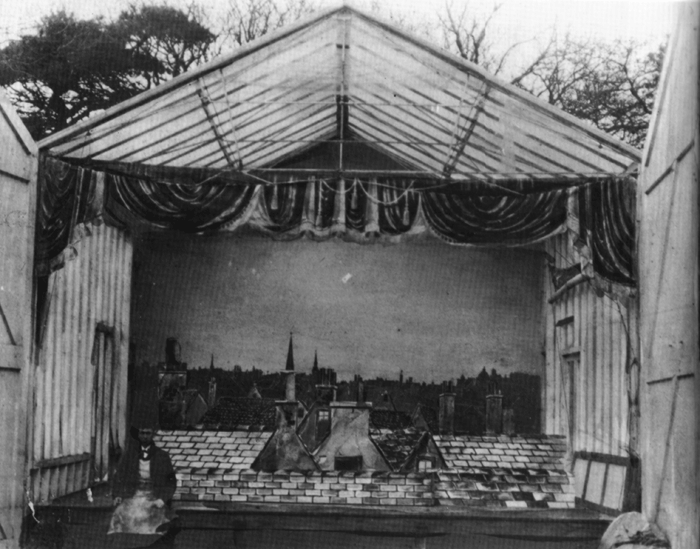
This film was filmed on his property in Montreuil, where he built a film studio in late 1896. The studio was like a greenhouse, with glass walls and ceiling, to utilize the available natural light—as artificial lights for motion picture production were not introduced until 1903, in the form of mercury vapor tubes. (Encyclopedia Britannica, 2022) This is also where A Trip to the Moon was filmed.
The great Victorian stage actor, Sir Henry Irving (the first actor to receive a knighthood),
starred in a production at the Lyceum in London in 1885, but based on images I have seen of Irving as Mephistopheles contained in the National Trust’s Collections, I do not believe the look of Mephistopheles to be based on Irving. However, in Méliès’ hand-colored remake of this film, which he produced the following year, 1897, Mephistopheles’ clothing is a strong red, similarly to Henry Irving’s costume.
Using the ability to shapeshift, as featured in both Goethe and Marlow’s adaptations,

Mephistopheles first appears upon the screen as a bat. Mephistophele’s shapeshifting into a bat is original to Méliès, and is not featured in either Goethe or Marlowe’s adaptations. Whether this is a vampire bat or not is never clarified. The bat alone is on the screen, hauntingly flapping its wings in what looks to be a corridor, before it transforms into . . .

. . . the human form of Mephistopheles, his wings transforming into the ends of his cape.

He then magically creates a large cauldron in the middle of the room. Though the title of the film reference’s the devil’s manor, this may be inspired by the Witch’s Kitchen of Goethe’s Faust, as that room had symbols related to black magic, and I do notice a star on the bottom of one of the pillars of Méliès’ set.

Then, in the middle ground, he conjures up an impish assistant, perhaps a reference to the character Phorkyas in Goethe’s Faust, out of a puff of smoke (as any good magician should). This imp then tends to heating the cauldron. (In the Witch’s Kitchen portion of Goethe’s Faust, a cauldron is also present, though it is tended to by a family of apes.) The actor plays this character with a crouched stance, and I wonder whether he was intending to appear as a little person.


The cauldron begins to smoke, and Mephistopheles conjures out of the smoking cauldron a woman appearing in Roman dress. She could be intended to be a Venus-like temptress, as in the Witch’s Kitchen portion of Goethe’s Faust, a nude Venus-like figure appears who arouses Faust’s lust. She could also simply be Méliès’ way to communicate that the potion in the cauldron induces arousal and lust. According to Mephistopheles in Goethe’s Faust, “With a drink like this in you, take care — You'll soon see Helens everywhere”—Helen’s meaning the beautiful and much-lusted-after Helen of Troy.
Mephistopheles then dismisses the woman in Roman dress and reviews a book of black magic that is being held for him by the impish assistant. The assistant then disappears into the door in the furnace which is heating the cauldron. Mephistopheles then makes the cauldron and oven themselves disappear. He seems to hear someone approaching, so swings his cape around himself and disappears.

Two gentlemen then appear and walk into the middle ground while chatting to one another. I am not sure who these gentlemen are supposed to be but speculate that one might be Faust and the other his assistant, Wagner, perhaps when Faust is still a scholar at university and meets Mephistopheles for the first time, with Mephistopheles demonstrating his power to Faust. Or they may instead be Valentine, the brother of Faust’s lover who does not approve of Faust leading his sister into sin and disrepute, and a friend. Later in Goethe’s story, Mephistopheles openly mocks Valentine shortly before helping Faust to kill him when Valentine challenges Faust to a fight. A third option is these are simply characters added by Méliès to be victims of Mephistopheles’ trickery, with no further meaning to them.

While the two men are chatting obliviously, Mephistopheles’ impish assistant suddenly
appears in a puff of smoke, carrying a pitchfork. As the two men face each other speaking, the impish assistant pokes one of the men in the backside with his pitchfork and then disappears quickly as the poked gentleman reacts in pain and confusion at what has struck him. As both men look in the direction from which this offense occurred, the imp reappears on the other side and again strikes. The men look behind them in time to see the impish assistant disappear.
One of the gentlemen, being a coward and shaking his knees, tries to leave. While the other gentleman attempts to make him stay, the cowardly gentleman is too frightened and runs out of the shot. The remaining gentleman reacts in a manner to communicate a frustrated ‘good riddance’ to his companion leaving and then tries to make sense of what has just transpired.

As he goes towards a bench in the room, it suddenly disappears and reappears on the other side of the room. The gentleman is shocked and confused by this. He goes to grab the bench, only for it disappear and reappear back in its original position. The gentleman makes gestures which communicate his confusion and his attempts to understand how this is happening.


He then goes to the bench and seeing that it is now remaining in its spot, attempts to sit on it, only find himself sitting on a skeleton. He quickly jumps up in shock and fright. The gentleman stares at and backs away from the skeleton, which is sitting relaxed with its left leg extended. The gentleman then removes his sword and as he strikes the skeleton, it turns into a bat. The man at first backs away in shock, but then attempts to grab the bat, which again transforms into the human form of Mephistopheles. Whatever character this gentleman is supposed to portray, he obviously recognizes the human form of Mephistopheles, as, for the first time since his strange encounters began, he cowers in fear.
Mephistopheles again conjures him impish assistant in a puff of smoke, who appears standing on the bench. To prove his power to the gentleman, Mephistopheles removes his cape, bundles it, and hands it to his impish assistant. The imp takes the balled-up piece of clothing, tosses it on the floor, and then performs a somersault using the cape as cushion for where his head would strike the ground. He does not complete the somersault, however, as when his head touches the cape, both the imp and the cape disappear.

The gentleman attempts to leave, but is blocked by 3 hooded figures, who, obviously being puppeted by Mephistopheles, close in on the gentleman and hover over him as he lowers to the ground and seems to lose consciousness. Quickly awakening, the gentleman seems to now be under the spell of Mephistopheles.

Mephistopheles brings out the lady in the Roman dress and it is obvious the gentleman is taken with her. He kneels and kisses her hand, only for the beautiful woman to transform into...
. . . An old, hooded hag carrying a staff. In horror, the gentleman backs away from the lady. He then draws his sword, but as he strikes the hag, she multiplies times six. All six hags lift their staves as though to strike
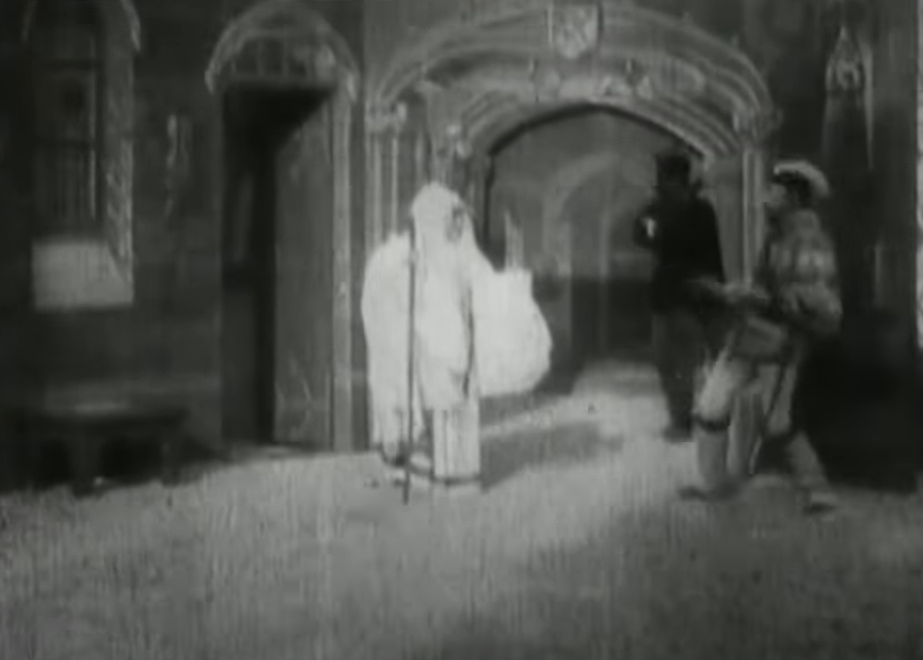
the gentleman.
The gentleman again backs away only to re-advance upon the reappearance of his cowardly friend. The two gentlemen then attempt to strike the hags with their swords, only for the hags to again transform into witches, complete with brooms.
Upon seeing this transformation, the cowardly friend again retreats. The witches follow him as he circles around the room, and he attempts to escape by jumping out the window or over the balcony. This may result in the cowardly gentleman’s death, as the other gentleman seems concerned by this action, and even Mephistopheles seems surprised by the act.

The gentleman had put his sword away upon seeing the hags turn into witches. He seems to attempt to get the witches’ attention or shoo them away, as they form a circle and begin to dance. As he nears them, they disappear. The gentleman closely inspects the area where the witches had been dancing and then throws his hands up in frustration. He then folds his arms, performs another action to say, “to hell with it”, and marches indignantly to leave—only to be blocked by Mephistopheles himself.

Mephistopheles attempts to either put the gentleman under a spell or cast a spell on him, as the gentleman slowly backs away. The gentleman then turns to run, spies an object, climbs the bench, and pulls from offscreen a large crucifix. The gentleman triumphantly holds the crucifix in his right hand, utilizing the cross as both sword and shield, as Mephistopheles cowers and retreats, the shadow of the crucifix consuming him.
Transfiguration, the devil, bats, witches, skeletons, cauldrons, creepy imps, temptresses, black magic—we can see why this qualifies as a horror film.
It has been suggested previously that the character of Mephistopheles in this film is a vampiric character and, therefore, the first screen portrayal of a vampire. Some have argued that Mephistopheles’ ability to turn into a bat and his ability to hypnotize, as well as the witches perhaps representing vampire brides, and his defeat by a crucifix, point to this being a vampiric figure.

I disagree. Bats have always had an association with the devil in terms of appearance; for Satan is trapped in the frozen central zone in the Ninth Circle of Hell, Inferno, Canto 34. Scanned, post-processed, and uploaded by Karl Hahn. Paul Gustave Doré, (1832-1883) (artist); Dante Alighieri, (1265-1321) (creator), Public domain, via Wikimedia Commons
example, in Dante’s Inferno, Satan is portrayed as having bat-like wings. And, again, Mephistopheles is an agent of the devil. Also, there is no indication that the bat in this film is a vampire bat.
Goethe’s Faust mentions the witch’s sabbath on Walpurgis night. There is also the figure of the witch in the Witch’s Kitchen portion of Faust. Additionally, witches have been traditionally depicted as celebrating the devil on the witch’s sabbath, including in a painting by Goya.

As Mephistopheles is an agent of the devil, it only makes sense that a crucifix would be necessary to exorcise him. Additionally, I believe a vampire being defeated or harmed by a crucifix was original to Stoker. So, as this predates Dracula, there was no trope at this time of vampires being affected by crucifixes. Therefore, I believe that the cross was only utilized by Méliès to exorcise the demon, Mephistopheles.
Additionally, Méliès specified the character’s name, Mephistopheles, which is a major character from literature. The story of Faust deals with alchemy and witches and demons—and, as a powerful demon and agent of the devil, Mephistopheles is certainly capable of performing all these feats that this character performs in the film. Additionally, the title of the film specifies “diable”, which, translated from French, means “devil”. So, I see no reason to think this film is to be about anyone other than Mephistopheles. However, I do think it’s reasonable to theorize that Méliès added some vampiric elements to his portrayal of Mephistopheles.
For those arguing that the character of Mephistopheles is portrayed as a vampire, or at least has elements of a vampire, it is possible, as bats and vampires were already a part of the popular imagination at the time of this film. Beyond the obvious relationship of the words vampire and bat because of the flying, blood-sucking mammal, some other correlations of bats and vampires or bats transforming into vampires happen chronologically as follows:
The Baital Pachisi, c. 11th Century

In Hindu mythology, there is a vampiric-type figure known as a vetala. The Baital Pachisi is a collection of stories, written in Sanskrit, compiled sometime before the 12th century. These were introduced to a Western audience through its loose adaptation by Sir Richard Burton, the explorer, writer, and translator, as Vikram and the Vampire in 1870. (As a side note, the explorer and translator Sir Richard Burton is not to be confused with the actor Richard Burton, who was twice married to Elizabeth Taylor—and no, the two are not related.) Here is a short passage from the “Introduction” to Vikram and the Vampire (1870), which seems to be one of the first times in literature a vampire is described not as a bat itself, but as a bat-like creature hanging by his feet from the limb of a tree:
“and so [the Raja] sat there for a while to observe the body, which hung, head downwards, from a branch a little above him. Its eyes, which were wide open, were of a greenish-brown, and never twinkled; its hair also was brown,[43] and brown was its face--three several shades which, notwithstanding, approached one another in an unpleasant way, as in an over-dried cocoa-nut. Its body was thin and ribbed like a skeleton or a bamboo framework, and as it held on to a bough, like a flying fox,[44] by the toe- tips, its drawn muscles stood out as if they were ropes of coin. Blood it appeared to have none, or there would have been a decided determination of that curious juice to the head; and as the Raja handled its skin it felt icy cold and clammy as might a snake. The only sign of life was the whisking of a ragged little tail much resembling a goat's. Judging from these signs the brave king at once determined the creature to be a Baital--a Vampire.” (Burton, 1970)
Punch Magazine, 1885
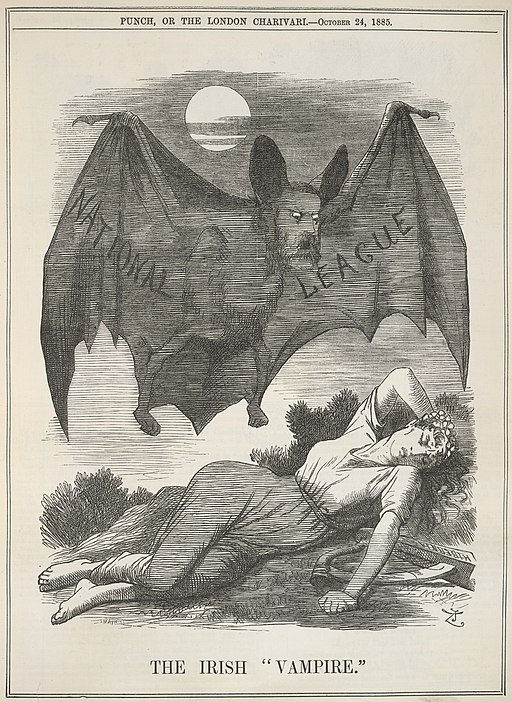
A cartoon in the British satirical magazine, Punch, from 1885, which calls the Irish National League “The Irish Vampire", portrays the League as a vampire bat. The bat’s face is that of Charles Stewart Parnell, the founder of the Irish National League. (Punch, 2022) This cartoon illustrates that the relationship between vampires and bats was already in the public consciousness by 1885, though whether this was before Burton’s writings in 1870 or not I can’t determine.
Méliès lived in London for a year in 1884, and he returned to Paris in 1885, so he would have been aware the pop-cultural association between vampires and bats being used in British culture in items like the Punch cartoon (1885) and in Richard Burton’s Vikram and the Vampire (1870).
I would like to again note that this film predates Stoker’s Dracula by one year. So, obviously, Méliès could not have taken any of this imagery or these ideas from Stoker. Bram Stoker had managed the Lyceum Theatre in London prior to writing Dracula. Because of this position, he knew many high-profile individuals, like the previously mentioned Sir Richard Burton, and was close with Sir Henry Irving, the first actor to receive a knighthood. Stoker’s wife had previously been courted by Oscar Wilde.
Stoker and Méliès would have actually both been involved in London theatre during the same time period, though, obviously, it’s unknown if they knew of one another. Considering there are many motifs in Méliès’ film that also appear in Stoker’s Dracula, I am curious as to whether Stoker saw this film and was, perhaps, influenced by it. While I believe Méliès uses the crucifix to exorcise a demon, as this demon also was able to transform into a bat, I wonder if this is where Stoker developed the idea for crucifixes to ward off vampires.
In an introduction to Dracula in the University of Leeds’ Special Collections, Dr. Emily Ennis claims that this Georges Méliès film was shown in London from 1896-1897, and that Stoker, working as manager at the Lyceum, “almost certainly saw Méliès’ film and positioned the novel Dracula in relation to it.” (University of Leeds Library, 2022)
So, while I don’t think that Méliès’ House of the Devil is a vampire film, I do think it’s possible that it helped to influence the creation of Dracula. That these horror tropes seem vampiric is only because Bram Stoker later used them for his own work, which then permeated popular culture and became part of the mythology of vampires.
Please subscribe to Rhapsody in 35MM wherever you like to listen to your podcasts. Also, subscribe to this website so you will be alerted to new postings such as this. Please make sure to follow us on the social media platform of your choice (or all of them!) -- the links can be found on this website. Please make sure to rate us and comment on Apple podcasts, or wherever you listen to podcasts. Until next time!
Sources
Burton, S. R. (1970). Vikram and the Vampire: Classic Hindu Tales of Adventure, Magic, and Romance. Retrieved from Sacred Texts: https://www.sacred-texts.com/goth/vav/index.htm
Calvert, P. (n.d.). Sir Henry Irving (1838-1905) as 'Mephistopheles' in 'Faust' by W. G. Wills. National Trust Collections. Smallhythe Place, Kent. Retrieved from the National Trust Collections: https://www.nationaltrustcollections.org.uk/object/1117183
Carey, E. (2018, October 4). Madame Tussaud: the astounding tale of survival behind the woman who made history. Retrieved from The Guardian: https://www.theguardian.com/books/2018/oct/04/madame-tussaud-edward-carey-little
Encyclopedia Britannica. (2022). Edison and the Lumiere Brothers. Retrieved from Encyclopedia Britannica: https://www.britannica.com/art/history-of-the-motion-picture/Edison-and-the-Lumiere-brothers
Encyclopedia Britannica. (2022). Professional Motion-Picture Production: Lighting. Retrieved from Encyclopedia Britannica: https://www.britannica.com/technology/motion-picture-technology/Lighting
Heise, W., Irwin, M., Rice, J. C., McNally, J. J., Thomas A. Edison, I. & Hendricks. (1896) May Irwin kiss. United States: Edison Manufacturing Co. [Video] Retrieved from the Library of Congress, https://www.loc.gov/item/00694131/
Library of Congress. (2022). Shift to Projectors and the Vitoscope (1895-1896). Retrieved from Library of Congress: https://www.loc.gov/collections/edison-company-motion-pictures-and-sound-recordings/articles-and-essays/history-of-edison-motion-pictures/shift-to-projectors-and-the-vitoscope/
Library of Congress. (n.d.). Inventing Entertainment: The Early Motion Pictures and Sound Recordings of the Edison Companies. Retrieved from Library of Congress: https://www.loc.gov/collections/edison-company-motion-pictures-and-sound-recordings/articles-and-essays/history-of-edison-motion-pictures/early-motion-picture-productions/#:~:text=It%20was%20dubbed%20the%20Black,it%20aligned%20with%20the%20sun
Punch. (2022). Cartoons about Ireland from Punch. Retrieved from Punch: https://magazine.punch.co.uk/image/I00008OZb2QpkY40
Solomon, M. (2012). Georges Méliès: Anti-Boulangist Caricature and the Incohérent Movement. Framework: The Journal of Cinema and Media, vol. 53, no. 2, 305-327.
The Georges Melies Project. (2022). The Story of Georges. Retrieved from The Georges Melies Project: https://www.thegeorgesmeliesproject.org/
The Ragtime Webring. (2022). Rags and Pieces by Scott Joplin (1895-1905). Retrieved from Internet Archive Wayback Machine: https://web.archive.org/web/20090606111507/http://www.perfessorbill.com/pbmidi15.shtml
Trevathan, C. E. (1896). "Bully" Song. Retrieved from National Museum of African American History & Culture: https://nmaahc.si.edu/object/nmaahc_2014.275.19
University of Leeds Library. (2022). Dracula. Retrieved from University of Leeds: https://library.leeds.ac.uk/special-collections/view/1261


Comments