Ep. 1: REMIXED - What’s in a Name? The Etymology and Science of Horror
Updated: Feb 1
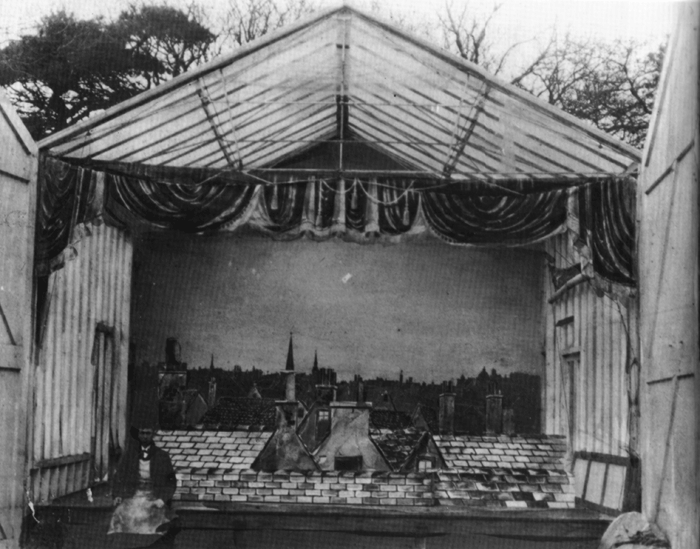
Horror is reflective of the dark side of human nature. It has reflected the darkness of our times, such as the violence of revolution and war being reflected in Madame Tussaud’s wax likenesses of the victims of the French Revolution. It has reflected the darkness of our talent for scientific progress and ability to play with nature, as illustrated by Mary Shelly in her literary masterpiece, Frankenstein; or the Modern Prometheus. Horror further reflects the darkness of our possible near future from pushing such limits—as symbolized in the Atomic-Age monster movies of the 1950s, which followed the atomic bombings of Japan and the witnessing of the effects of nuclear radiation.
And it reflects the darkness within our own, individual nature; the darkness within our own soul; of our own duality, as represented in Strange Case of Dr. Jekyll and Mr. Hyde by Robert Louis Stevenson. The vanity and ego of human nature means that we like to view ourselves, see ourselves reflected back to us, through oral tradition, literature, song, and film—and the genre of horror illustrates that we seem to be particularly fascinated by, if not infatuated with, the darkest aspects of our nature. That this is entertainment, and that we are “entertained” by viewing the darkest aspects of ourselves, and by having it reflected back to us, speaks volumes about who we are.
Etymology of "horror"
When discussing horror and genre, it is beneficial to first define what horror is. Phrike, meaning “shudder” (Martin, 2019), or shivering, is often used in Greek and Roman literature to describe what Dr. David Cairns of The University of Edinburgh states is “fundamentally a physical experience, the experience of a body that shivers and shudders.” Phrike could also connote revulsion, as evidenced by the reaction to the first century, Jewish historian Josephus’ account of the siege of Jerusalem, when a starving woman cannibalized her own son to illustrate to her Jewish guards the extreme desperation and depravation to which they had driven her. (Cairns, 2015)
The feeling of “shuddering” or horror was personified as one of the demons of Greek mythology, also referred to as Phrike. According to Encyclopedia Britannica, in Greek religion, a “demon” is a supernatural power, and was often associated with “sudden or unexpected supernatural interventions not due to any particular deity.” And, while Homer used the term “theos”, meaning a god, and “demon”, interchangeably when referring to a god, the difference lies in “theos” stressing a god’s personality, while demon stresses a god’s activity.
“Hence, the term demon was regularly applied to sudden or unexpected supernatural interventions not due to any particular deity. It became commonly the power determining a person’s fate, and a mortal could have a personal demon. As early as Hesiod (c. 700 BC), the dead of the Golden Age became demons; and later philosophical speculation envisaged these as lower than the gods (possibly mortal) but as superior to humanity.” (Britannica, 2022)
Phrike is akin to the Greek demons Phobos, the personification of fear and panic, and Deimos, the personification of dread. Phrike was referenced, though not personified, in works by the first century Roman philosopher and dramatist, Seneca, (Wikisource contributors, 2019); and the 5th century BCE Greek tragedians, Sophocles (Garvin, Robinson, & (Eds.), 2004) and Aeschylus (Aeschlysus (c. 460 BCE, 2006 trans.). For a bit of extra trivia, Phobos and Deimos are also the names of Mars’ two natural satellites.

Dr. Cairns of The University of Edinburgh describes Phrikē as partly an involuntary physical reaction, “one that is part of human beings’ pre-human inheritance and rooted in basic systems of bodily regulation that respond to changes in the temperature of the organism and of the environment. As a symptom of emotion, and especially of fear-like emotions, it is a member of a set of related symptoms that are also recognized in our own folk models (“I shudder to think”, “it gives me the shivers’, “he was in a cold sweat”, ‘she’s got cold feet”, “it was a chilling/hair-raising experience”) and confirmed by empirical investigation.” (Cairns, 2015)
As an interesting side note, Phrike may also be the possible origination of the word “Africa”. The prefixes “a”, such as in “abyss”, and “an”, such as in “anemia”, are Greek negative prefixes meaning “not” or “without.” (Damen, n.d.) So, when attaching a negative prefix to a word like “symptomatic”, it becomes “asymptomatic”, meaning “no symptoms” or “without symptoms”. Daniel Don Nanjira states that one possibility for Africa’s etymology is the combining of the Greek word, “Phrike”, which he defines as “cold, connoting horror”, with the Greek negative prefix “a”, again, meaning “not” or “without”. The word would become “a-Phrike”—or Africa— “without” “cold and horror”, or "a land free of cold and horror.” (Nanjira, 2010)
The actual word, “horror”, is derived from the Latin verb “horrere.” (Merriam-Webster, 2022) It came into English through the French. The French language is descended from Latin, having developed in the region the Romans called Gaul, and which now comprises present-day France, Luxemburg, and Belgium, as well as parts of Switzerland, Northern Italy, and Germany. (Harrison, 2022) According to the British Library, England was already using French as an administrative language by the dawn of the 13th century, including having Magna Carta copied into French in 1215, shortly after King John attached the Great Seal. Indeed, several texts on the laws and customs of London, which are now held by the British Library, were translated into French during this time. (Marcos, 2022) This is also the period when the word “horror” entered the English language. (Merriam-Webster, 2022)
According to Merriam-Webster, the Latin verb “horrere” means “to stand up, to bristle; to have a rough, unkempt appearance; to shudder or shiver, as from the cold; or to tremble with fear. The “bristle” sense became the basis for the original meaning of the Latin noun horror [meaning] “the action or quality (in hair) of rising or standing stiffly, [or] bristling”. Bristling from cold or fear—shuddering or shivering—led to the development of the meaning “a quality or condition inspiring horror” or “a thing which brings terror.” The symptom became the cause.”
The Science of Fear
The various meanings of horror--cold, bristling, shuddering—are all necessary responses to a perceived stress. We tremble or shudder because the stress hormone adrenaline is surging, preparing us to fight or take flight. Similarly, we bristle because we are readying for danger—we are tense, and we are aware of and sensitive to a possible threat. (O'Sullivan, 2022) Perhaps we enjoy exploiting these feelings through various forms of entertainment because they provide us with a training ground for when we face real danger.
As many games and sports, like wrestling teaching self-defense, are developed with the goal of allowing one to use play to learn, perhaps we utilize horror as a genre and are entertained by it because it prepares us for dealing with shocking, startling, or scary elements while in a safe environment and desensitizes us to elements that we may find repulsive. Perhaps we are biologically wired to enjoy things which prime us for the potential ugly realities of the human experience, such as war.
Additionally, we are inherently curious about the unknown, about what lies in the shadows of human nature, the human experience, and the natural world. And horror often serves to allow us to peek at what lies in those shadows—and, like rubbernecking at a car accident, we get a glimpse at elements about which we are curious, but that we wouldn’t want to experience. And, perhaps, for some fans of horror, it allows them to vicariously experience the dark interests and impulses which lie in the corners of their mind. Horror also often provides us with explanations for what lies in the darkness—offering answers for why certain curiosities or abnormalities happen and/or how they came into being—for example, psychologically, as with Norman Bates, or supernaturally, as with The Exorcist.
It is this fear at a distance, or controlled fear—the fear we experience on roller coasters—that creates excitement and allows for the enjoyment of horror. It is the jumping out of an airplane—but with the control and safety of a parachute. If we didn’t find some fear exciting, we would never venture into unknown waters. As Dr. Bruce Kawin states, “Horror is part of our response to the world.” (Kawin, 2012)
But does bristling and shuddering truly define what we experience when we watch horror? Dr. G. Neil Martin writes that “Behaviorally, horror film can create shivering, closing of the eyes, startle, shielding of the eyes, trembling, paralysis, piloerection, withdrawal, heaving, and screaming (Harris et al., 2000). It can produce changes in psychophysiology, specifically increasing heart rate and galvanic skin response. Mentally, it can create anxiety, fear, empathy, and thoughts of disgust (Cantor, 2004).” (Martin, 2019)
The responses to watching horror films can be vast and extreme. And the subgenres of horror films are just as vast and extreme. Some horror films feature no violence at all, others are entirely composed of it. Some rely on psychology, hauntings, or suggestions of the strange or supernatural to cause horror; while others, violence and/or elements causing repulsion and disgust are present throughout.
I, personally, do not like graphic violence. My favorite horror films include The Bride of Frankenstein, The Innocents, and Gremlins. Many of my favorites contain gothic elements, camp, and/or humor. Indeed, one of my favorite musicals is Sondheim’s Sweeney Todd: The Demon Barber of Fleet Street. I am not someone who seeks out or enjoys watching Texas Chainsaw Massacre or the films in the Saw franchise. And I can’t even fathom what goes on in the mind of Dutch filmmaker, Tom Six, who came up with The Human Centipede—I can only assume that his having been involved as a director on the original Big Brother, which originated as a Dutch reality show, warped his mind.

This difference in male and female response to horror may be explained by disgust sensitivity. Disgust sensitivity is simply the sensitivity one has to various types of disgust; including moral disgust, such as one may have toward political issues; social disgust, such as that displayed against specific groups (like racism); and by elements that are literally physically contaminating. We developed disgust as a protective reaction to possible infections. (Haidt, Olatunji, & and Rozin, 2012) and (Albani, Brahler, Paul, Petrowski, & Schmutzer, 2010)). Women tend to have a higher disposition to both anxiety and disgust sensitivity than men; therefore, women may be more sensitive to the disgust and/or anxiety-causing elements often found in horror, which will lessen their enjoyment of the genre as compared to men. (Martin, 2019)
Per Dr. Martin, though the literature demonstrates that the clearest indicators regarding preference for horror and graphic violence are based on one’s sex, a study from 2009 (Weaver & Wilson, 2009) found that, unless an individual conveys a specific liking for graphic violence, the response to such violence is generally negative. Additionally, non-violent programs were found to be more enjoyable than those with violence (Weaver & Wilson, 2009), which is supported by a 2005 study that found that the removal of violent content from films did not affect the enjoyment of the film. (Sparks, Sherry, & Lubsen, 2005) Furthermore, a 2011 study focusing on selective exposure to and enjoyment of media violence suggests that even individuals who seek out graphic violence may not enjoy actually watching it. (Weaver A. J., 2011)
As sex seems to be the most evident factor in determining the enjoyment of horror, especially horror containing graphic violence, I’m curious as to where transgender and nonbinary individuals fit into these statistics, and whether any horror preferences change with the altering of hormones. I’m also curious as to what are specifically biological behaviors in response to horror versus conditioned behaviors related to social constructs.
I’m also curious as to what are biological versus socially-conditioned behaviors in response to horror; for example, are young men more inclined to enjoy violent horror films and video games than young women because of cultural and/or social conditioning, or is it the biology of men at that age?
But now that we’ve examined what horror is, who its audience is, and why, let’s take a look at what exactly makes a horror film, including the techniques behind creating images and sounds that cause fear. Join us on episode 2, as we discuss these elements, in this brief introduction to the horror genre. Join me, if you dare!
Please subscribe to Rhapsody in 35MM wherever you listen to your podcasts. Also, subscribe to this website so you will be alerted to new postings such as this. Please make sure to follow us on the social media platform of your choice (or all of them!) -- the links can be found on this website. Please make sure to rate us and comment on Apple podcasts, or wherever you listen to podcasts. Until next time!
Sources
Aeschlysus (2006, t. (c. 460 BCE). Prometheus Bound. Retrieved from Poetry in Translation: https://www.poetryintranslation.com/PITBR/Greek/Prometheus.php
Albani, C., Brahler, E., Paul, S., Petrowski, K., & Schmutzer, G. (2010). Domains of disgust sensitivity: revisited factor structure of the questionnaire for the assessment of disgust sensitivity (QADS) in a cross-sectional, representative german survey. BMC Medical Research Methodology, 10(95).
Bohan, W., & Tripathy-Lang, A. (2022, 04 20). USArray listens to earthquakes’ inaudible infrasound. Retrieved from Incorporated Research Institutions for Seismology: https://www.iris.edu/hq/science_highlights/usarray_listens_to_earthquakes_inaudible_infrasound
Breznican, A. (2022, 07 10). The Exorcist: 10 creepy details from the scariest movie ever made. Retrieved from Entertainment Weekly: https://ew.com/movies/2012/10/31/the-exorcist-10-creepy-details/
Britannica, T. E. (2022). "demon". Retrieved from Encyclopedia Brittanica: https://www.britannica.com/topic/demon-Greek-religion
Cairns, D. (2015). The horror and the pity. Psychoanalytic Inquiry, 75-94. Retrieved from https://www.pure.ed.ac.uk/ws/portalfiles/portal/24339649/Cairns_Horror_and_Pity.pdf
Callahan, R. (2020, 08 25). Attorney: Woman was in body bag 2 hours before found alive. Retrieved from Associated Press: https://apnews.com/article/ap-top-news-mi-state-wire-us-news-95f9cfb633fb5cd54c820c5c8f627ca6
Damen, M. (n.d.). Greek Prefixes. Retrieved from Utah State University: https://www.usu.edu/markdamen/wordpower/handouts/gkaffix.pdf
DeVoto, M. (2013, 10 09). "tritone. Retrieved from Encyclopedia Britannica: https://www.britannica.com/art/tritone
Garvin, T., Robinson, F., & (Eds.), a. t. (2004,12 27). The Project Gutenberg EBook of The Seven Plays in English Verse, by Sophocles. Retrieved from The Gutenberg Project: https://www.gutenberg.org/files/14484/14484-h/14484-h.htm
Geaghan-Breiner, M., & Giannini, A. (2021, 09 13). 7 tricks horror movies use to scare you. Retrieved from Insider: https://www.insider.com/horror-movie-techniques-ways-movies-trick-you-into-being-scared-2021-8
Haidt, J., Olatunji, B., & and Rozin, P. (2012, 10 16). The Disgust Scale Home Page. Retrieved from NYU Stern School of Business: https://pages.stern.nyu.edu/~jhaidt/disgustscale.html
Harrison, R. (2022). Development From Latin To French. Retrieved from Cogitatorium: http://rharriso.sites.truman.edu/latin-language/latin-and-french/#:~:text=The%20French%20language%20is%20derived,to%20the%20Romans%20as%20Gaul.
Jekyll, G. (n.d.). Jekyll & Hyde and RL Stevenson. Retrieved from Gertrude Jekyll: The Official Web Site of the Jekyll Estate: https://gertrudejekyll.co.uk/
Kawin, B. F. (2012). Horror and the Horror Film. New York: Anthem Press.
King, S. (2010, 09 24). Being buried alive is old ground in the movies. Retrieved from Los Angeles Times: https://www.latimes.com/archives/la-xpm-2010-sep-24-la-et-buried-movies-20100924-story.html
Kogan, J. (2017, 10 31). The Unsettling Sound Of Tritones, The Devil's Interval. Retrieved from NPR: https://www.npr.org/2017/10/31/560843189/the-unsettling-sound-of-tritones-the-devils-interval
Leventhall, G. (2007). What is infrasound? Progress in biophysics and molecular biology, 130-137.
Longdon, V. (2018, 06 18). What is a tritone and why was it nicknamed the devil’s interval? Retrieved from Classic FM: https://www.classicfm.com/discover-music/music-theory/what-is-a-tritone/
Maio, A. (2019, 12 12). What is Shallow Focus? How Can it Help Your Cinematography? Retrieved from Studio Binder: https://www.studiobinder.com/blog/shallow-focus/
Marcos, H. (2022). The French language before 1200. Retrieved from British Library: https://www.bl.uk/medieval-english-french-manuscripts/articles/the-french-language-before-1200
Martin, G. N. (2019). (Why) Do You Like Scary Movies? A Review of the Empirical Research on Psychological Responses to Horror Films. Frontiers in Psychology, 10(2298).
MasterClass. (2021, 06 07). Depth of Focus Vs. Depth of Field: What’s the Difference? Retrieved from MasterClass: https://www.masterclass.com/articles/depth-of-focus-vs-depth-of-field
Merriam-Webster. (2022). The Hirsute History of 'Horror'. Retrieved from Merriam-Webster: https://www.merriam-webster.com/words-at-play/the-hirsute-history-of-horror#:~:text='Horror'%20comes%20from%20a%20Latin,person's%20hair%20stands%20on%20end.
Nanjira, D. D. (2010). African Foreign Policy and Diplomacy from Antiquity to the 21st Century, Volume 1. Westport: Praeger Publishers.
Nevada Film Office. (2018, 10 22). PRODUCTION NOTES: NON-LINEAR SOUNDS. Retrieved from Nevada Film Office: https://nevadafilm.com/production-notes-non-linear-sounds/#:~:text=What%20Are%20Non%2DLinear%20Sounds,or%20an%20animal's%20vocal%20chords
O'Sullivan, S. (2022, 06 06). Why Anxiety Can Make You Literally Shake - & What To Do About It. Retrieved from Refinery29: https://www.refinery29.com/en-gb/anxiety-shakes-how-to-stop
Sparks, G. G., Sherry, J., & Lubsen, G. (2005). The appeal of media violence in a full‐length motion picture: An experimental investigation. Communication Reports, 21-30.
Tamborini, R. &. (1987). Predictors of horror film attendance and appeal: An analysis of the audience for frightening films. Communication Research, 415-436.
Weaver, A. J. (2011). A meta-analytical review of selective exposure to and the enjoyment of media violence. Journal of Broadcasting & Electronic Media, 232-250.
Weaver, A., & Wilson, B. (2009). The Role of Graphic and Sanitized Violence in. Human Communication Research, 442-463.
Wikisource contributors. (2019, 05 21). Tragedies of Seneca (1907) Miller/Oedipus. Retrieved from Wikisource: https://en.wikisource.org/w/index.php?title=Tragedies_of_Seneca_(1907)_Miller/Oedipus&oldid=9272339


Comments